The Standard Delivery Window: What 8:00 AM to 6:00 PM Actually Means
For millions of Filipino consumers, e-commerce entrepreneurs, and corporate logistics coordinators, knowing when a courier will arrive at the door is critical. Whether you are awaiting an urgent passport renewal document, a high-value laptop, or a Cash on Delivery (COD) social commerce order, being away from home when the rider knocks can cause missed handovers and delivery delays.
Officially, LBC Express operates its door-to-door domestic delivery network between 8:00 AM and 6:00 PM, Monday through Saturday. However, this ten-hour timeframe does not mean a courier is equally likely to arrive at any minute of the day. Last-mile parcel delivery is an intricately structured, route-optimized operation governed by geography, traffic density, commercial opening hours, and vehicle dispatch cycles.
Understanding how delivery riders structure their daily runs helps customers anticipate the most probable delivery window for their specific address, prepare exact Cash on Delivery funds, and coordinate with household members or building receptionists to ensure seamless first-attempt delivery.
LBC's standard domestic delivery window runs from 8:00 AM to 6:00 PM, Monday through Saturday. Sunday home delivery is not part of standard operations, although select high-volume retail mall branches open on Sundays for counter drop-offs and customer parcel pickups.
The Anatomy of a Courier Rider's Daily Shift: From Hub Staging to Final Return
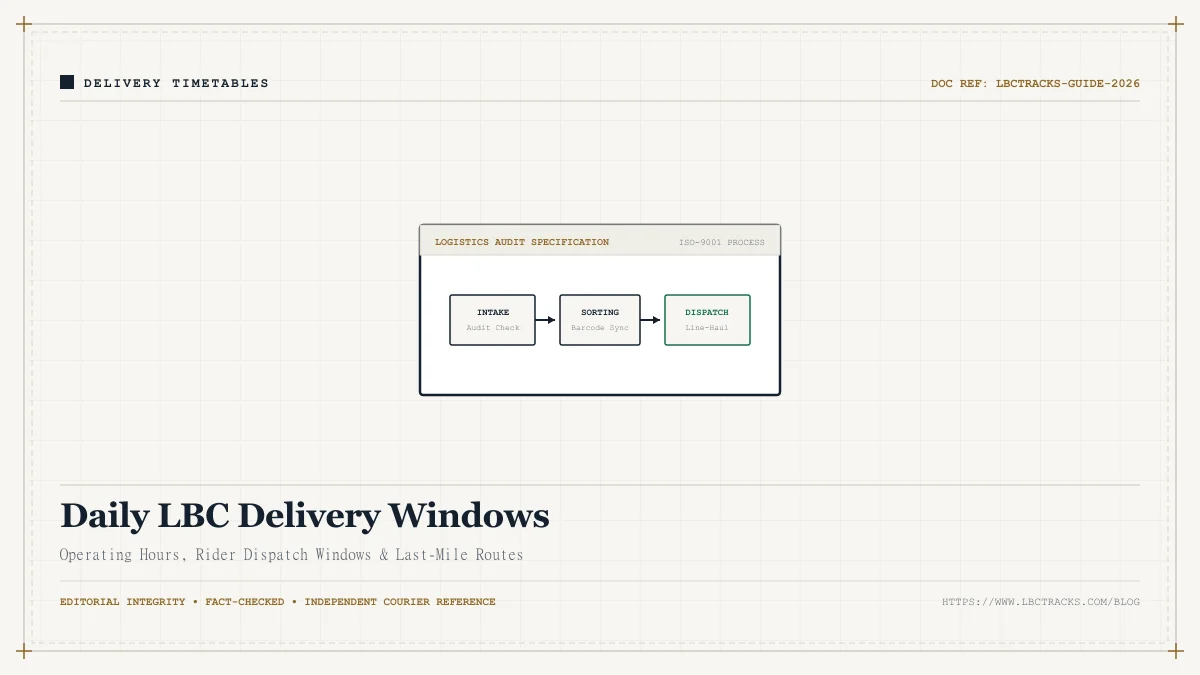
During the morning hub sort (06:30 AM to 08:30 AM), riders scan each package barcode using handheld enterprise terminals or LBC's proprietary rider mobile application. This physical scan triggers the automated status update "Out for Delivery" on public tracking portals and prompts the system to queue transactional SMS notifications to recipients whose mobile numbers are active on the waybill.
| Time Window | Operational Phase | Rider Activities & Focus | Customer Impact & Tracking Status |
|---|---|---|---|
| 06:30 AM - 08:30 AM | Hub Inbound Staging & Manifest Audit | Sorting arriving line-haul parcels, scanning waybills into mobile run-sheets, organizing delivery bag by neighborhood zone. | Shipment status updates online to "Out for Delivery" or "Assigned to Rider." |
| 08:30 AM - 12:00 PM | Morning Run: Commercial & Institutional Route | Delivering time-sensitive business documents, bank instruments, corporate pouches, and office park orders. | Office workers receive corporate deliveries during standard morning business hours. |
| 12:00 PM - 01:00 PM | Midday Route Meal & System Refresh | Mandatory meal break, route re-sequencing, synchronizing completed morning deliveries via mobile scanner. | Temporary pause in active door knocks; morning milestone receipts process across servers. |
| 01:00 PM - 05:30 PM | Afternoon Run: Residential & Subdivision Route | Navigating residential subdivisions, condominiums, barangay compounds; collecting Cash on Delivery payments. | Peak residential delivery window; homeowners receive doorbell knocks and SMS arrival alerts. |
| 05:30 PM - 07:00 PM | Re-Attempt Runs & Hub Debrief | Conducting second attempts for earlier unreachable recipients; returning to hub to remit COD cash and undelivered parcels. | Parcels with failed deliveries scan as "Attempted - House Closed" or stage for next-day dispatch. |
Commercial vs. Residential Windows: How Couriers Sequence Daily Routes
A fundamental operating principle of express couriers is route sequencing based on building accessibility. Riders do not crisscross neighborhoods randomly; their delivery manifests are geographically batched to maximize fuel efficiency and delivery completion rates.
Commercial Office Districts (09:00 AM to 12:00 PM): Corporate offices, legal practices, commercial banks, government agencies, and retail business establishments operate under strict 9:00 AM to 5:00 PM operating windows, frequently with dedicated receiving rooms that close by lunchtime or mid-afternoon. Consequently, LBC riders dispatch to office towers, central business districts (such as Makati CBD, Bonifacio Global City, Ortigas Center, and Cebu IT Park), and commercial strip malls first. If your delivery address is an office building, expect your parcel between mid-morning and noon.
Residential Neighborhoods & Subdivisions (01:00 PM to 06:00 PM): Home deliveries, apartment buildings, residential condominiums, and barangay interiors are scheduled primarily for the afternoon shift. By afternoon, commercial routes have cleared, traffic patterns in residential pockets stabilize, and recipients returning from morning errands or shift work are more likely to be home. The vast majority of residential doorbells are rung between 1:30 PM and 5:00 PM.
Saturday and Weekend Delivery Operations: What Operates and What Pauses
A pervasive myth among online shoppers in the Philippines is that courier services halt entirely over the weekend. For LBC Express, Saturday is a full, active operating day across the nationwide delivery network.
Riders conduct regular deliveries on Saturday, following identical schedules to weekday runs. In fact, Saturday delivery completion rates in residential subdivisions frequently exceed weekday figures because working professionals and family members are home to accept packages and settle Cash on Delivery balances.
Sunday Operations: LBC does not conduct regular doorstep deliveries on Sundays. Last-mile motorcycle couriers and delivery van drivers are off-duty. However, Sunday is not completely dormant within the LBC network:
- Mall Branch Operations: LBC branches situated inside major shopping malls (such as SM Supermalls, Ayala Malls, and Robinsons Malls) are open on Sundays, mirroring standard shopping center retail hours (typically 10:00 AM to 9:00 PM).
- Branch Pick-up Availability: If your package was shipped as Cash on Pick-up (COP) or Hold for Pick-up to a mall branch, you can visit the branch on Sunday, present your tracking code and valid ID, and claim your parcel.
- Inter-Hub Transit: Long-haul highway freight trucks and inter-island container vessels continue moving across Sunday to position shipments for Monday morning delivery runs.
Standalone Street Branches vs. Shopping Mall Counters: Operating Hours and Cutoffs
Customers frequently confuse branch counter opening hours with last-mile courier delivery windows. If you plan to drop off an outbound shipment or claim a package held at a retail branch, note the distinct operating differences between branch categories:
Standalone Street-Level Branches: These neighborhood retail stores typically operate from 8:00 AM to 5:00 PM, Monday through Saturday. A small number of high-traffic flagship branches open at 7:30 AM or close at 5:30 PM. Standalone branches close on Sundays and official statutory holidays. Their critical shuttle cutoff occurs between 12:00 PM and 2:00 PM; parcels tendered after cutoff stage for the next business day.
Shopping Mall Branches: Located within commercial retail malls, these branches adhere to the host mall's schedule—generally 10:00 AM to 8:00 PM or 9:00 PM, seven days a week. Mall branches provide extended convenience for evening drop-offs and weekend pick-ups, though their outbound shuttle consolidation usually departs once daily in the late afternoon.
Gated Communities and Condominiums: Special Delivery Procedures
Navigating residential subdivisions, private executive villages, and high-rise condominium towers represents one of the most time-consuming aspects of a courier's afternoon run. In Metro Manila, Metro Cebu, and major provincial cities, private homeowner associations (HOAs) and property management offices enforce strict security gate protocols that directly influence when and how a parcel reaches your hands.
Subdivision Guardhouse Clearance: Couriers riding motorcycles or driving light delivery vans must surrender a valid government ID or courier company badge at subdivision gates to receive a visitor gate pass. In strict residential enclaves, guards will not grant entry unless the homeowner has pre-cleared the courier or confirmed their presence via intercom or telephone. If guards cannot reach the resident, the courier is turned away at the gate, logging an "Attempted - Gated Community Access Denied" exception.
High-Rise Condominium Receiving Policies: For residential condominium buildings, couriers are rarely permitted to ride elevators to individual unit doors due to resident privacy and building safety regulations. Standard procedure requires the courier to coordinate with the ground-floor concierge or property management desk. If the building maintains an authorized parcel receiving room, the security officer logs the delivery into the building register and accepts the parcel on behalf of the tenant (provided the shipment is prepaid). For Cash on Delivery (COD) consignments, the resident must physically descend to the lobby with exact payment to meet the courier in person.
Weather Disruptions and PAGASA Storm Protocols: When Delivery Hours Shift
Tropical weather patterns exert an immense influence on daily courier delivery hours across the Philippine archipelago. Between annual monsoon downpours (Habagat and Amihan), tropical depressions, typhoons, and extreme summer heat indices, courier field operations must balance delivery speed with courier safety and cargo integrity.
PAGASA Tropical Cyclone Wind Signals: When the Philippine Atmospheric, Geophysical and Astronomical Services Administration (PAGASA) raises Tropical Cyclone Wind Signal No. 1 or higher over a locality, LBC Express activates localized contingency guidelines. Under Signal No. 1, motorcycle couriers continue operating with caution, utilizing heavy-duty waterproof tarpaulins and sealed inner plastic linings. However, once Signal No. 2 is raised or local government units (LGUs) declare localized flash flood emergencies, all motorcycle dispatches are immediately suspended. Deliveries are either reassigned to high-clearance closed freight vans or deferred until wind and rain subside.
Urban Flooding and Street Inundation: In low-lying metropolitan areas (such as Malabon, Navotas, parts of Manila, and low-lying coastal barangays across Central Luzon and the Visayas), afternoon high tides combined with seasonal rains routinely render secondary roads impassable for delivery two-wheelers. Couriers encountering flooded streets document the obstacle via their mobile terminals. Parcels on affected routes are scanned as "Delayed Due to Inaccessible Road / Flood" and rescheduled for the earliest safe delivery window on the following business day.
Missed Delivery Protocols: Failed Attempts, Notices, and Branch Holding
What happens if the courier arrives at your address while no one is home to receive the package? LBC enforces structured operational procedures to resolve undelivered items before initiating a Return to Sender (RTS) workflow:
Rider Outreach via SMS or Call
Upon arriving at an unanswered doorbell, gated subdivision checkpoint, or building lobby, the courier calls or texts the consignee phone number indicated on the waybill.
Initial Failed Attempt Scan
If the recipient is unreachable, the rider logs a delivery exception scan (e.g., "Consignee Not Around" or "House Closed"). This status appears on the online tracking portal within hours.
Automatic Second Delivery Attempt
LBC standard policy includes up to two (2) complimentary doorstep delivery attempts. The second attempt is scheduled on the next consecutive business day.
Transfer to Local Holding Hub / Branch
If the second attempt fails, the parcel is not immediately returned to the sender. It is transferred to the nearest local distribution hub or designated delivery branch for temporary custody.
Five-Day Claim Window Before RTS
The consignee has five (5) calendar days to claim the parcel in person at the local branch with a valid ID before the courier initiates formal Return to Sender procedures.
Practical Strategies for Ensuring Successful First-Attempt Deliveries
Preventing missed deliveries requires proactive coordination between the buyer and the carrier. Implement these practical measures to ensure your package is received on the first attempt:
1. Keep Mobile Phones Active and Accessible: Couriers rely heavily on phone calls when navigating unfamiliar streets or gated subdivision guard gates. Ensure the mobile number provided during checkout is powered on and capable of receiving cellular calls throughout the delivery day.
2. Prepare Exact Cash for COD Shipments: Delivery riders carry limited change floats for security reasons. Fumbling for exact change or requesting the rider to wait while you visit an ATM causes delivery friction and can lead to aborted drop-offs.
3. Delegate an Authorized Receiver: If you must leave your residence during delivery hours, leave an authorization note, a photocopy of your valid government ID, and the exact payment (if COD) with a trusted household member, neighbor, or building concierge.
4. Opt for Cash on Pick-up (COP) When Schedules are Unpredictable: If your work schedule makes receiving home deliveries difficult, request the sender to address the shipment to your nearest LBC branch as COP. You can then collect the parcel on your own schedule within five calendar days.