Immediate Assessment: What to Check First When You Lose the Physical Slip
Misplacing a paper courier slip is an everyday occurrence. Thermal paper, by its chemical nature, is treated to react to heat rather than traditional ink. Friction from wallets, heat inside bags or vehicles, and prolonged exposure to ambient sunlight cause thermal print to fade to complete illegibility within days or weeks. However, the most critical fact to understand at the outset is that losing your physical paper receipt does not cancel, stall, or misplace your shipment. The physical parcel continues along its transit journey because the courier's official barcoded routing label was already printed and affixed to the exterior pouch or box during counter intake.
Before rushing out the door or stressing over misplaced paperwork, take a breath and conduct an immediate digital audit. Most people carry the recovery keys right inside their smartphones. Modern retail logistics ecosystems generate digital footprints at multiple transaction touchpoints: automated carrier dispatch notifications, electronic payment confirmations, smartphone camera rolls, and digital messaging threads between sender and recipient.
Senders frequently snap an informal photograph of the transaction counter or receipt immediately after tendering the box to share with the recipient on messaging apps like Viber, WhatsApp, or Facebook Messenger. Even if you do not consciously recall taking a picture, check your recent photos album, chat history with the consignee, or automated cloud photo backups from the date of dispatch. If a digital snapshot exists, even a slightly blurry one, you can usually read the primary tracking digits and solve the problem in seconds.
The physical package travels based on the routing label pasted onto the pouch, not the receipt in your pocket. As long as the destination address and recipient phone number on the parcel label are complete and accurate, the courier will attempt delivery within standard regional transit timetables.
Searching SMS Message Inboxes and Carrier Dispatch Alerts
When an LBC counter associate processes a package at intake, one of the mandatory terminal prompts requires entering the mobile phone numbers for both the sender and the designated consignee (recipient). This intake data powers LBC's automated notification service. As the parcel is scanned into the originating distribution exchange, the system automatically triggers an outbound SMS alert.
If you are the sender, open your smartphone's default SMS app and search specifically for the sender name or keyword "LBC", "waybill", or "tracking". Do not simply scroll through your messages; use the search query bar to scan through archived messages, promotional tabs, and carrier shortcodes. Automated dispatch notifications typically display the complete tracking number (for standard retail domestic deliveries, a 12-digit numeric sequence).
If you are the recipient awaiting a delivery, check your own SMS inbox. Recipients frequently receive automated delivery status alerts once the parcel undergoes primary sorting at the regional hub or is assigned to a last-mile delivery rider. If you find a message confirming that an LBC package has been booked or dispatched to your name, the 12-digit code embedded in that message is your active tracking key.
It is worth noting why an SMS might fail to arrive: if the sender made a single-digit clerical error when dictating the recipient's phone number at the counter, or if network congestion delayed transactional SMS gateway relays, the text alert will not reach your device. In that scenario, move directly to digital payment audit logs.
Locating Transaction References in Digital Payment Records
If freight charges were settled using an electronic payment method rather than cash, you hold a verifiable, timestamped financial record of the exact drop-off. Most Philippine courier branches now accept digital payments via GCash QR, Maya QR, and major debit or credit cards.
Open your e-wallet application (such as GCash or Maya) and navigate to your Transaction History or Activity tab. Locate the payment entry corresponding to the date and approximate time you visited the courier counter. Open the detailed digital receipt and take a screenshot.
This transaction record displays vital metadata that an originating branch can use to locate your file in their internal register log:
- Merchant Partner / Account Name: Confirms the payment was processed through the official LBC Express merchant terminal.
- Exact Timestamp: Records the calendar date, hour, and minute the register closed the transaction.
- Total Amount Paid: Matches the freight charge calculated for your pouch size, weight, or distance tier.
- Reference Number / Trace Number: The payment gateway approval code (such as a 12-digit GCash Ref No. or card authorization code).
Your GCash or Maya transaction reference number is NOT your courier tracking number. Entering an e-wallet reference code into an online tracking portal will return an "Invalid Number" error. Instead, this payment reference serves as the primary search key that the branch cashier uses to pull up your specific register session in their internal terminal database.
Step-by-Step Decision Protocol: From Digital Logs to Branch Records
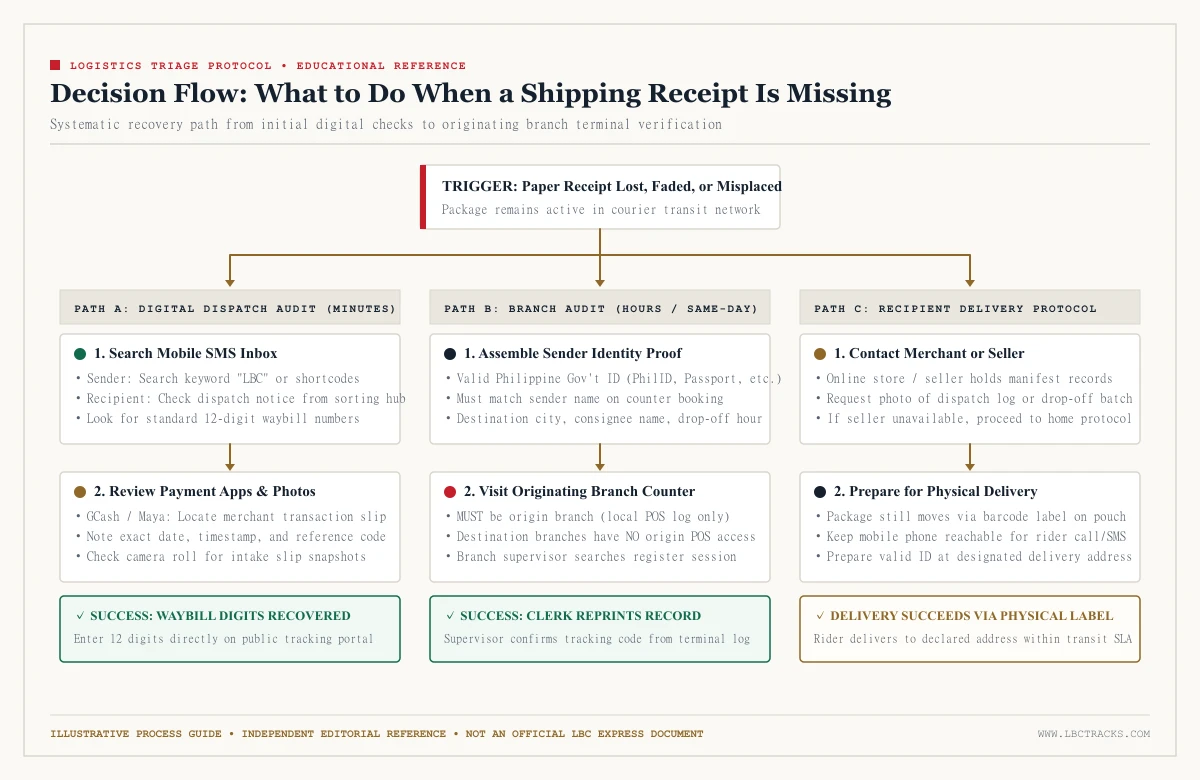
Navigating a lost receipt requires following an orderly escalation path. Attempting to skip steps—such as calling general customer telephone support before checking your phone messages or visiting a random local branch—wastes hours without producing results.
Follow this systematic recovery protocol in order of speed and operational effectiveness:
Audit Personal Digital Footprints (Minutes)
Inspect smartphone message archives, chat histories with the consignee, payment app transaction slips, and photo albums for any record of the drop-off or automated dispatch alert.
Compile Shipment Metadata (5 Minutes)
Before contacting anyone, write down the tender date, approximate time window, tender branch name, recipient's declared full name, destination city, and package type.
Sender Conducts Origin Branch Audit (Same-Day / Next-Day)
If digital avenues yield no number, the registered sender visits the exact originating branch tender counter with a valid government photo ID to request a terminal lookup.
Consult Customer Care with Specific Data
If an in-person branch visit is impossible, submit a formal written inquiry through official channels providing the complete verified transaction metadata.
Initiate Consignee Delivery Protocol
If the tracking code remains unrecoverable, monitor standard delivery transit windows and ensure the destination delivery address has an authorized recipient available with valid ID.
Visiting the Originating LBC Branch for a POS Audit Lookup
When self-service digital recovery fails, the definitive in-person remedy is a point-of-sale (POS) audit log retrieval. However, this option comes with strict operational and regulatory constraints that every customer must understand.
First and most importantly, you must visit the exact branch where the package was originally tendered and paid for. Do not visit a branch near your home if you shipped the package from an office branch across the city, and do not visit the destination delivery branch in another province. Courier point-of-sale cash registers operate on decentralized local daily settlement journals. The branch cashier can only browse the transaction register of their own physical counter terminals.
Second, only the registered sender whose name was recorded at intake has legal standing to request a transaction lookup. Counter personnel are legally prohibited from disclosing transaction records to third parties, casual acquaintances, or even family members without formal legal authority.
Acceptable Philippine Government Identification
To access terminal transaction logs, the sender must present at least one valid, unexpired government-issued photo identification card that matches the sender name on the shipment record. In accordance with Philippine government identity standards, accepted primary IDs typically include:
- Philippine Identification System (PhilID / ePhilID): The official national identity card.
- Philippine Passport: Issued by the Department of Foreign Affairs (DFA).
- Driver's License: Issued by the Land Transportation Office (LTO).
- Unified Multi-Purpose ID (UMID): Issued by SSS or GSIS.
- Postal ID: Current digital/biometric version issued by PHLPost.
- Professional Regulation Commission (PRC) ID: For licensed professionals.
- Voter's Certification / Voter's ID: Issued by the Commission on Elections (COMELEC).
What Specific Details You Must Provide to Counter Staff
Branch personnel do not have a broad search engine that lists all shipments by keyword. Cash register journals record hundreds of transactions per shift. To help the branch supervisor locate your record efficiently, prepare the following details on paper or on your phone before stepping up to the counter:
- Exact Drop-Off Date and Estimated Hour: Specifying "Tuesday between 2:00 PM and 3:30 PM" narrows the journal from thousands of entries to a manageable 90-minute window.
- Consignee Full Legal Name and Mobile Number: The exact name written on the address label.
- Destination Municipality or City: For example, "Mandaue City, Cebu" or "Davao City".
- Package Category and Size: Pouch (Small, N-Pouch, Regular, XL) or Kilobox (Mini, Slim, Small, Medium, Large).
- Payment Method and Proof: The GCash/Maya reference number, card terminal slip, or the exact cash payment amount.
Visit the branch during mid-morning (9:30 AM to 11:30 AM) or early afternoon (2:00 PM to 3:30 PM). Avoid peak lunchtime rushes (12:00 PM to 1:30 PM) and late afternoon closing hours (4:30 PM to 6:00 PM), when staff are actively packing outbound line-haul consignments and reconciling end-of-day cash registers.
Receipt Anatomy: Identifying the Real Tracking Code vs Promotional QR Codes
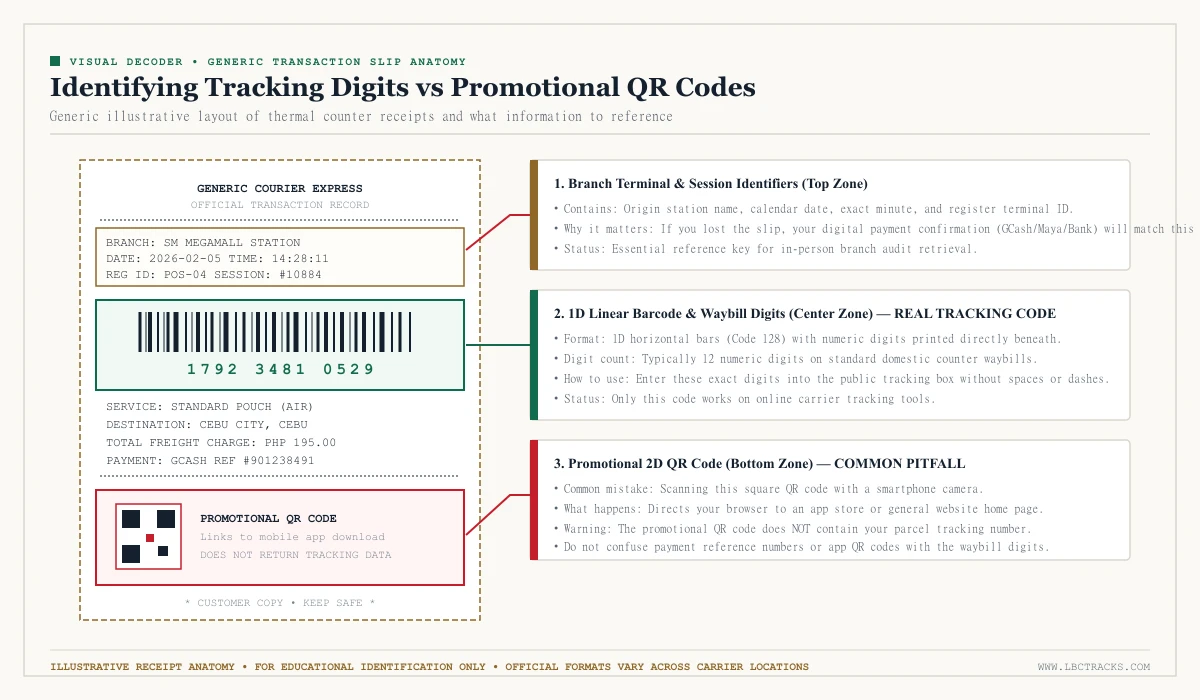
A surprisingly common scenario occurs when a customer has a faint receipt or a cropped photograph of their transaction slip, but cannot determine which cluster of numbers represents the actual tracking code. Modern courier receipts display multiple alphanumeric strings, tax identification numbers, terminal IDs, barcodes, and two-dimensional QR codes. Entering the wrong string into a tracking bar creates unnecessary frustration.
Thermal courier transaction slips feature two distinct machine-readable graphics that serve completely different purposes:
| Code Label | Visual Format | Typical Length / Syntax | Online Tracking Functional? |
|---|---|---|---|
| Tracking / Waybill Number | Printed beneath 1D linear barcode bars | 12 numeric digits (domestic standard retail) | YES — Official tracking key for website & app |
| Branch POS Transaction Ref | Printed near top header / cashier line | Alphanumeric session code (e.g., POS-04 #10884) | NO — Internal store register audit record only |
| Digital Payment Ref (GCash/Maya) | Printed in payment summary line | 9 to 13 digits (payment gateway transaction ID) | NO — Financial settlement reference only |
| Promotional Mobile App QR Code | Square 2D matrix graphic at bottom | Static URL link to app stores | NO — Marketing download link only |
| International Air / Ocean Booking | Printed on cargo declaration manifest | 5 numeric digits (Balikbayan / sea freight) | YES — Tracks cross-border container & air cargo |
The 1D Linear Barcode: The True Tracking Identifier
The true tracking code is represented by a traditional 1D horizontal linear barcode (symbology standard Code 128) located in the upper-to-middle portion of the thermal receipt.
Directly below these vertical parallel lines, the system prints the alphanumeric or numeric tracking digits. For standard retail domestic deliveries across the Philippines, this is typically a 12-digit numeric sequence (such as 1792 3481 0529). When typing this number into the LBC tracking number tool, enter only the 12 digits sequentially without adding spaces, hyphens, or punctuation.
The 2D QR Code: A Common Promotional Trap
On modern LBC transaction receipts, you will frequently notice a square 2D QR code printed near the bottom edge. Many customers attempt to scan this QR code using their smartphone camera, expecting it to launch a real-time parcel map or delivery status update.
In reality, this square QR code is purely promotional. It contains a static hyperlink directing mobile users to download the LBC Connect mobile app from the Apple App Store or Google Play Store, or opens the corporate home page. It contains no shipment-specific data, no waybill number, and no tracking status. Scanning it will not track your parcel.
Data Privacy Regulations and Why Courier Lookups Are Restricted
Customers frequently ask: "Why can't I just call the LBC customer service hotline, tell them my name and address, and have the telephone representative look up my tracking number?"
The refusal of phone support staff to search shipments by recipient name is not arbitrary unhelpfulness; it is a strict legal and security safeguard mandated by Republic Act No. 10173, commonly known as the Data Privacy Act of 2012, regulated by the National Privacy Commission (NPC) of the Philippines.
Under Philippine data privacy legislation and commercial transport regulations, couriers handle personal identifiable information (PII) including full legal names, private residential addresses, direct mobile telephone numbers, declared commodity descriptions, and package valuation. Disclosing shipment manifests or tracking codes over an unauthenticated telephone connection creates severe risks:
- Parcel Diversion Fraud: Malicious actors who discover someone expects a parcel could call customer support, impersonate the consignee, obtain the tracking number, and request a fraudulent reroute or branch pick-up transfer.
- Identity Spoofing and Social Engineering: E-commerce scammers exploit courier dispatch details to fabricate fake delivery demands or extract cash-on-delivery payments from unsuspecting households.
- Harassment and Physical Stalking: Disclosing sender or recipient addresses to unverified callers compromises personal safety and domestic security.
Because telephone agents cannot physically verify a caller's government photo identification, biometric identity, or signature over an ordinary voice line, carrier policy strictly restricts staff from performing open-ended name queries. Customer service representatives can only review an active consignment when the caller already provides the exact matching tracking number and independently verifies security questions.
What the Recipient Can Do When the Sender Is Unavailable
The situation is especially stressful for consignees. If you are the designated recipient waiting for an urgent package, but the sender has misplaced the receipt and has become unreachable—due to travel, time zone differences, illness, or poor communication—what concrete actions can you take?
While a recipient cannot walk into a branch and demand access to another person's tender history, several practical pathways remain open:
Engaging Online Sellers and E-Commerce Merchants
If the shipment originates from an e-commerce purchase (such as an online boutique, social commerce vendor, or corporate supplier), contact the seller through their official customer care or order management channel. Commercial merchants routinely keep consolidated daily dispatch manifests, bulk booking spreadsheets, or photographs of tender pouches.
Request that the seller's logistics coordinator check their daily dispatch manifest for your order number and full name. Even if the paper slip was filed away or discarded, enterprise drop-off manifests record all 12-digit waybills processed in that commercial batch.
Handling Packages When the Tracking Number Is Permanently Lost
What happens if all recovery efforts fail? The sender has lost the paper receipt, paid in untraceable cash, deleted all SMS logs, cannot visit the originating branch, and the tracking number is permanently unrecoverable. Does the package vanish into thin air?
The answer is an emphatic no. The physical movement of a package through the courier logistics network relies entirely on the barcoded routing label physically pasted onto the surface of the pouch or box at intake. That physical label contains the full recipient delivery address, destination bar-code, and the recipient's contact phone number. Couriers do not require the sender or recipient to track a package online for that package to reach its destination.
To ensure successful delivery when you cannot monitor real-time tracking updates, follow these critical precautions:
Familiarize Yourself with Standard Delivery Timelines
Calculate your expected delivery arrival window based on standard courier operational lead times across the Philippines (consult our detailed LBC delivery transit time guide for regional breakdowns):
- Within Metro Manila (NCR to NCR): 1 to 3 business days following drop-off.
- Metro Manila to Major Provincial Luzon: 2 to 5 business days.
- Luzon to Visayas or Mindanao Major Hubs: 3 to 7 business days.
- Island Municipalities and Remote Provincial Feeder Routes: 7 to 10+ business days.
Keep Contact Numbers Active and Prepare for Last-Mile Arrival
During the estimated arrival window, ensure the mobile phone number declared at intake remains powered on, active, and capable of receiving voice calls and SMS. Last-mile couriers and delivery dispatch riders typically call or send an SMS when navigating nearby streets or entering gated subdivisions, condominium lobbies, or barangay checkpoints.
Advise household members, building concierge desks, or village security personnel that a parcel addressed to your name is expected. Leave a photocopy of your valid ID and a signed authorization slip with your representative at home if you will be away during regular delivery hours (8:00 AM to 6:00 PM).
What Happens If Delivery Fails (Undelivered / Missed Route)
If the courier rider attempts delivery but nobody is available to receive the box, or if the address lacks a landmark, the driver logs a delivery exception. For detailed steps on resolving failed drops, consult our tracking troubleshooting guide.
Parcels with failed attempts are returned to the assigned local delivery team hub. Couriers typically hold retail packages for up to five (5) business days before initiating return-to-sender (RTS) procedures. If your expected delivery window lapses by more than 48 hours without delivery or contact, visit your nearest local LBC delivery hub with your valid government ID and proof of address to inquire about parcels awaiting delivery under your full legal name.
Common Mistakes to Avoid When Managing Lost Shipping Slips
When dealing with the stress of lost shipping receipts, customers often commit preventable mistakes that prolong delays or create confusion. Avoid these common traps:
- Mistake 1: Visiting the destination branch instead of the origin branch. Destination counter staff have zero access to tender cash register records in another city. Save your transit fare; only the origin station can pull POS logs.
- Mistake 2: Typing payment reference numbers into tracking portals. GCash, Maya, and credit card approval codes are financial identifiers, not carrier waybill numbers. They will always return "Consignment Not Found" on tracking search bars.
- Mistake 3: Repeatedly scanning the promotional QR code on a photographed slip. That QR graphic directs users to mobile app stores. Look exclusively for the 12 numeric digits printed directly beneath the 1D linear barcode.
- Mistake 4: Discarding faded thermal slips without snapping a photo. As soon as you receive a thermal slip at any courier counter, develop the immediate habit of taking a sharp, well-lit smartphone photograph. Even if the physical paper fades or is lost, the digital photo preserves the waybill forever.
- Mistake 5: Assuming a missing tracking number means a lost package. Do not submit premature insurance claims or initiate panic disputes. Physical parcels travel based on the glued label, not the customer's paper receipt.