The Core Reality: Why Public Courier Search Bars Require Waybill Numbers
One of the most frequent questions asked by anxious recipients and rushed senders across the Philippines is straightforward: "Can I track my LBC package using just my name, my mobile phone number, or my home delivery address?" Perhaps an online seller sent a package but forgot to provide the receipt, or a family member shipped a care box from the province but lost the tracking slip before texting the digits.
The definitive operational answer is no. You cannot search, trace, or monitor an LBC package on any public online tracking portal, smartphone tracking application, or telephone customer service hotline using only personal identification details. The public LBC tracking system is architected to accept only the official courier tracking identifier—for standard retail domestic deliveries, a 12-digit numeric sequence printed directly beneath the 1D linear barcode on the shipping label.
Understanding why this limitation exists requires looking past initial inconvenience. Restricting public search functionality to the unique waybill key is neither an oversight nor a technical defect; it is a critical security architecture designed to safeguard personal data, prevent cargo diversion fraud, and protect millions of households from unauthorized surveillance.
Standard domestic retail pouches and boxes across the Philippines utilize a 12-digit numeric tracking number (such as 1792 3481 0529). Specialized consular visa documents or corporate logistics consignments may utilize 15 digits, while international ocean cargo (Balikbayan boxes) uses 5-digit numbers. None of these formats can be substituted with customer names or phone numbers on public portals.
Database Architecture: Relational Primary Keys vs Free-Text Search
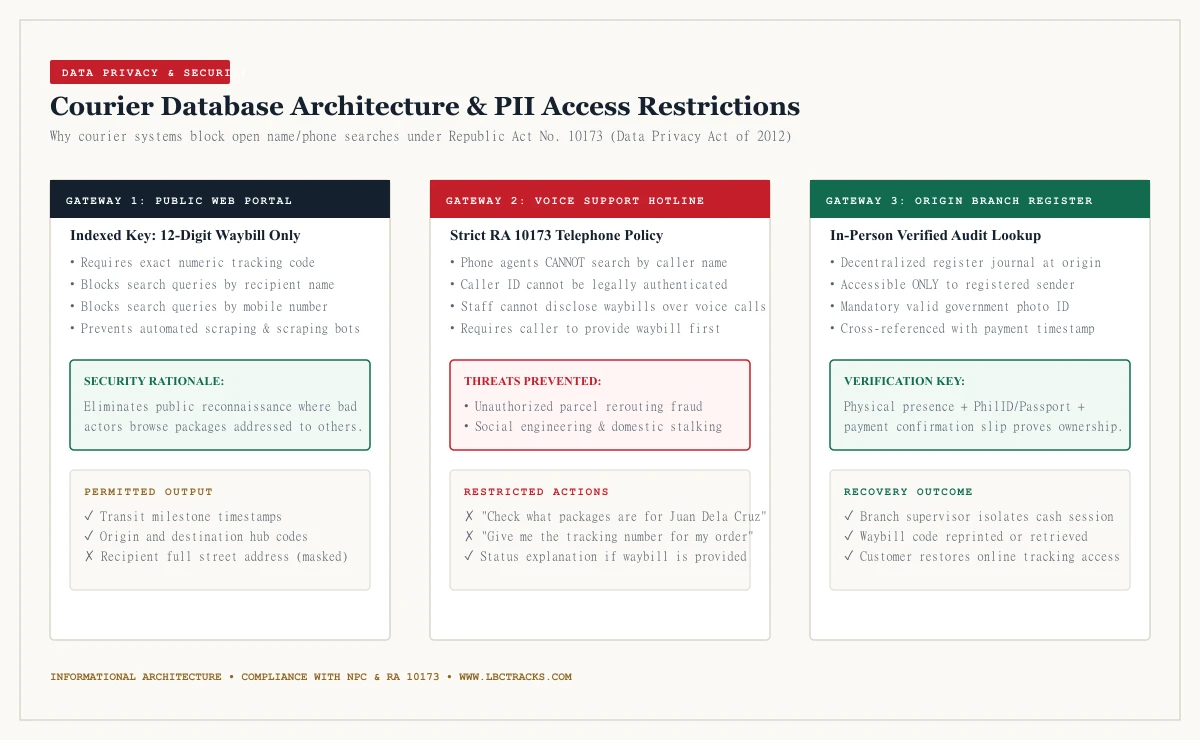
To comprehend why a courier cannot simply "look you up by name," consider the sheer operational scale of commercial logistics networks in the Philippines. On any given business day, courier networks process hundreds of thousands of individual consignments across Luzon, Visayas, and Mindanao. In a relational enterprise database handling tens of millions of historical and active parcels, the 12-digit waybill number serves as the primary key.
A primary key guarantees absolute uniqueness: exactly one physical box or pouch corresponds to that specific numeric sequence. Conversely, personal identifying details are notoriously ambiguous in a country of 115 million citizens:
- Severe Name Collisions: A query for common names such as "Maria Santos", "Juan Dela Cruz", or "Jose Reyes" would return hundreds of active deliveries simultaneously across Metro Manila alone. A system cannot guess which parcel belongs to which inquirer.
- Address Orthographic Variations: Philippine street addresses frequently lack standardized formatting. Variations in spelling (e.g., "Brgy. San Antonio", "Barangay San Antonio", "Bgy. 402"), missing building unit numbers, or localized landmarks prevent automated relational indexing without introducing massive error rates.
- Decoupled Database Normalization: To optimize high-throughput laser scanning at distribution hubs—where sorting belts scan up to 10 parcels per second—conveyor sorting logic reads purely the linear Code 128 barcode. The physical conveyor router does not parse sender or consignee names during high-speed transit.
Data Privacy Safeguards: Why Couriers Block Name and Phone Queries
Beyond database mechanics, the most rigid barrier preventing open-ended customer searches is legal compliance. In the Philippines, the collection, processing, and disclosure of personal data are strictly governed by Republic Act No. 10173, commonly known as the Data Privacy Act of 2012, enforced by the National Privacy Commission (NPC).
Every courier shipping manifest contains sensitive Personally Identifiable Information (PII): full legal names, private residential addresses, direct cellular telephone numbers, declared commodity descriptions, and package valuation. Permitting open-ended search queries would trigger catastrophic privacy and security vulnerabilities:
Parcel Diversion and Impersonation Fraud
If courier databases allowed public queries by recipient name, unscrupulous individuals could enter the names of neighbors, business executives, or celebrities to monitor when high-value goods (such as smartphones, designer jewelry, or legal documents) are dispatched. Armed with this transit visibility, scammers could impersonate the recipient, intercept the delivery rider on the street, or present forged identification at local delivery hubs to claim the package fraudulently.
Social Engineering and Delivery Phishing Scams
Fraud syndicates exploit parcel details to execute sophisticated social engineering scams. If bad actors could discover that a household is expecting a parcel, they could send deceptive SMS text messages demanding "clearance fees" or dispatch bogus Cash on Delivery (COD) couriers with worthless dummy boxes before the genuine rider arrives. For comprehensive defense strategies, consult our guide on preventing LBC shipping scams.
Why Customer Care Hotlines Cannot Disclose Tracking Codes
Many customers assume that while a website might block name searches, a human customer care agent on the phone can bypass the rule. However, telephone customer support representatives are bound by identical regulatory restrictions. Because voice telephone calls cannot authenticate government-issued photo cards, biometric data, or physical signatures, carrier policy prohibits representatives from performing unauthenticated database queries.
Do not expect telephone customer care representatives to search internal databases by your name, phone number, or street address. Representatives can only pull up a consignment record when the caller already provides the exact 12-digit waybill tracking number and independently answers security verification questions.
Recovery Action Matrix: Legitimate Ways to Track When You Have No Number
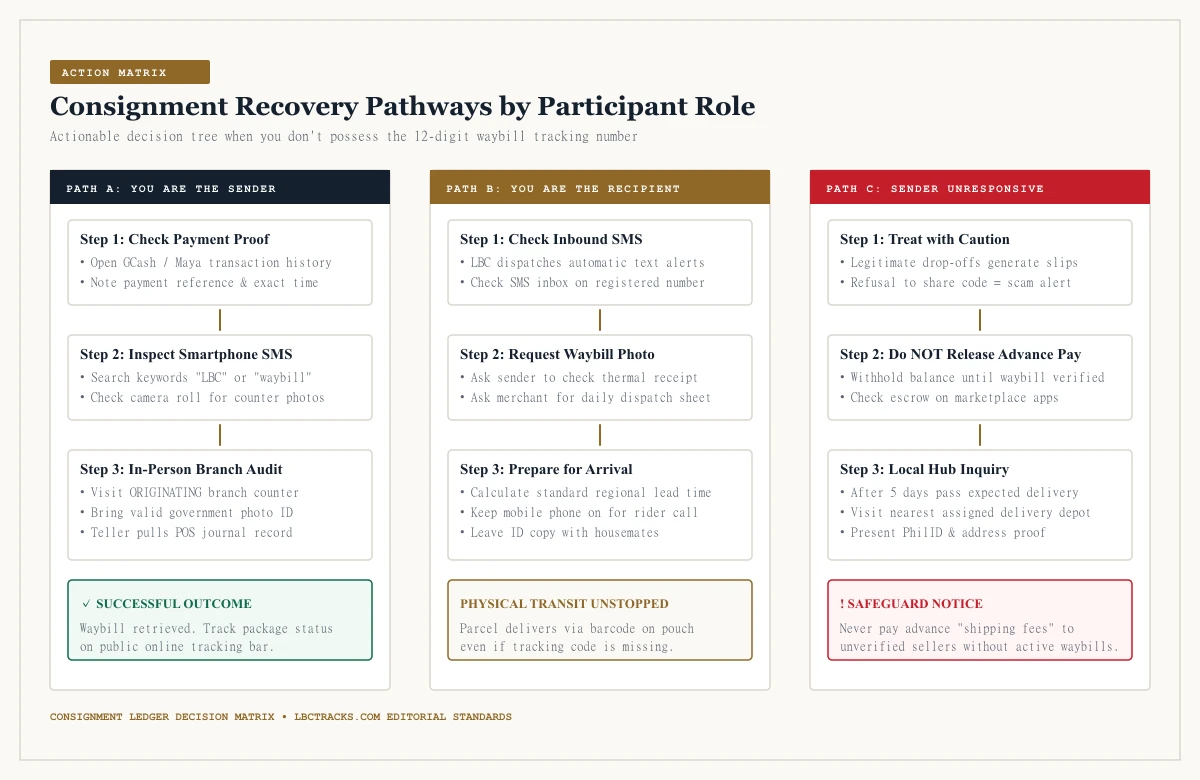
While public search engines cannot look up packages by name, you are not entirely powerless. Depending on whether you are the person who shipped the item, the recipient awaiting delivery, or an online buyer purchasing from an independent merchant, specific legitimate protocols exist to recover the 12-digit waybill key:
Audit Personal Digital Footprints (Minutes)
If you paid for shipping electronically via GCash, Maya, or bank debit/credit card, open your transaction history. Locate the merchant payment record matching the drop-off timestamp; this payment reference serves as the primary search key for branch register audits.
Search Mobile SMS Inboxes for Carrier Dispatch Texts
Search your smartphone SMS messaging app for the sender name "LBC" or keywords "waybill" and "tracking". Senders and recipients whose 11-digit mobile numbers were registered at counter intake receive automated carrier dispatch alerts containing the 12-digit code.
Request Dispatch Manifest Snapshot from Sender or Merchant
If you are the buyer, contact the seller through their official platform chat. Legitimate online vendors maintain daily drop-off manifests or bulk booking spreadsheets recording every 12-digit waybill dispatched in that batch.
Sender Conducts In-Person Origin Branch Register Audit
When all digital methods fail, the registered sender must visit the exact physical branch where the package was tendered, carrying a valid Philippine government photo ID to request a point-of-sale journal lookup.
In-Person Origin Branch Register Audit (Sender Procedure)
When digital searches yield no record, the definitive remedy is an in-person point-of-sale (POS) terminal journal audit. However, this recovery path requires strict adherence to courier operating guidelines:
First and foremost, you must visit the exact branch where the package was originally tendered and paid for. You cannot visit a branch near your home if you shipped from an office location, and destination delivery hubs in other provinces hold zero records of origin counter registers. Courier counter registers operate on decentralized daily financial journals stored locally on the cashier terminal.
Second, only the registered sender whose legal name was encoded at intake has legal standing to request a record lookup. Branch staff will refuse requests made by third parties, friends, or unverified recipients.
| Touchpoint / Channel | Search by Name / Phone Permitted? | Search by 12-Digit Waybill Permitted? | Operational Requirement |
|---|---|---|---|
| Public Website / App Tracker | NO — Strictly blocked by system | YES — Standard real-time query key | Requires exact 12-digit code without spaces |
| Telephone Customer Care Hotline | NO — Prohibited under RA 10173 | YES — Milestone updates provided | Caller must provide waybill + verify security questions |
| Originating Tender Branch Counter | YES — Within local POS register journal | YES — Full reprint capability | Verified sender in person with valid government photo ID |
| Destination Delivery Hub / Depot | NO — Decentralized register separation | YES — Physical staging inspection | Recipient in person with valid ID matching pouch label |
Acceptable Philippine Government Photo Identification
To inspect cash register audit journals, the sender must present at least one original, unexpired government-issued photo identification card matching the name on the shipment record. In compliance with Philippine identity verification standards, accepted primary IDs include:
- Philippine Identification System (PhilID / ePhilID): The official national identification card.
- Philippine Passport: Issued by the Department of Foreign Affairs (DFA).
- Driver's License: Issued by the Land Transportation Office (LTO).
- Unified Multi-Purpose ID (UMID): Issued by SSS or GSIS.
- Postal ID: Current biometric digital version issued by PHLPost.
- Professional Regulation Commission (PRC) ID: For registered professionals.
- Voter's Certification / Voter's ID: Issued by COMELEC.
Information the Sender Must Provide to the Cashier
Branch cashiers process hundreds of transactions per shift. To help staff locate your file without scrolling through thousands of lines, prepare the following specific metadata before approaching the counter:
- Exact Calendar Date and Approximate Time Window: For example, "Tuesday, October 14, between 1:30 PM and 2:30 PM."
- Consignee Legal Name and Destination Municipality: The exact name and town/city written on the pouch routing label.
- Pouch Size or Box Dimensions: Whether you sent an N-Pouch, Regular Pouch, XL Pouch, or Kilobox (Small, Medium, Large).
- Payment Method and Proof: E-wallet transaction reference code (GCash/Maya) or exact cash settlement figure.
What Recipients Can Do When the Sender is Unreachable
Being the recipient of an unindexed parcel is uniquely challenging. If you are expecting an urgent package, but the sender has lost the paperwork and has become temporarily unreachable—due to international travel, illness, or broken communication—what practical steps can you take?
While a recipient cannot legally demand to browse another person's drop-off register at an originating branch, you can protect your delivery through alternative operational workflows:
Engaging Corporate Merchants and Online Vendors
If the shipment originates from a commercial merchant (such as a social commerce shop, clothing boutique, or corporate supplier), message their customer support team. Established e-commerce merchants maintain consolidated daily dispatch manifests recording every 12-digit waybill handed over to courier dispatch riders. Provide your order number, invoice code, or payment screenshot so their logistics coordinator can pull the matching carrier waybill from their spreadsheet.
Preparing Household and Workplaces for Last-Mile Arrival
When tracking numbers cannot be recovered, transition from digital monitoring to physical readiness. Advise household members, building receptionists, condominium concierge desks, or subdivision security guards that an incoming parcel addressed to your legal name is expected. If you will be away during standard delivery hours (8:00 AM to 6:00 PM), leave a signed authorization letter and a photocopy of your valid ID with a trusted representative at home.
What Happens to Packages When Tracking Numbers Are Lost Forever?
A widespread customer fear is that losing the tracking number causes the package to disappear or stall in transit. This is an absolute misconception. Packages move based on the physical routing label affixed to the pouch or carton, not the paper receipt in your pocket.
Once a parcel is tendered at intake, the counter associate applies a thermal adhesive label bearing the linear barcode, destination routing hub code, recipient address, and recipient contact telephone number. That physical label travels with the parcel through sorting hubs, regional line-haul trailers, air containers, and delivery vans.
To ensure delivery succeeds without online tracking visibility, monitor standard regional transit schedules (consult our detailed guide on LBC delivery turnaround times):
- Within Metro Manila (NCR to NCR): 1 to 3 business days following intake.
- Metro Manila to Major Provincial Luzon: 2 to 5 business days.
- Luzon to Major Visayas or Mindanao Hubs: 3 to 7 business days.
- Island Feeder Routes and Out-of-Delivery Remote Areas: 7 to 10+ business days.
If a delivery rider attempts delivery but nobody is home or your phone is unreachable, the driver records a delivery exception notice. Couriers typically hold packages at the assigned local delivery team hub for up to five (5) business days before initiating Return-to-Sender (RTS) procedures. If your regional transit window lapses by more than 48 hours without arrival, visit your local municipal delivery depot with valid ID to claim the parcel.
Common Pitfalls, Scams, and Tracking Myths to Avoid
Anxiety over missing tracking codes often leads customers to fall for fraudulent schemes or waste hours pursuing impossible recovery methods. Avoid these common traps:
- Myth 1: Third-party apps claiming to "track any package by mobile number". Numerous fraudulent mobile apps and phishing websites claim they can locate any Philippine courier delivery simply by entering a phone number. These services are data-harvesting operations designed to steal personal information or subscribe devices to premium SMS billing. Never enter phone numbers on unauthorized tracking websites.
- Myth 2: Attempting to track via courier rider phone numbers or vehicle plates. Courier delivery riders handle dozens of parcels across varying routes daily. Courier dispatch databases do not index packages by vehicle plate numbers or rider personal phones, and customer support representatives cannot track parcels using rider contact details.
- Myth 3: Typing e-wallet or bank reference codes into courier tracking bars. Entering an 11-digit or 13-digit GCash/Maya reference number into an online courier tracking tool will immediately return "Consignment Not Found." Payment references belong exclusively to financial settlement gateways.
- Myth 4: Discarding faded thermal receipts without taking a photo. Thermal paper fades rapidly when exposed to sunlight, heat, or wallet friction. Make it an unbreakable habit to snap a sharp, high-resolution smartphone photo of your courier counter receipt immediately upon stepping away from the intake counter.
- Myth 5: Filing premature lost-cargo insurance claims. Do not initiate formal loss claims or dispute charges while the package is still within standard regional transit timetables. The vast majority of unindexed parcels arrive safely on schedule.