The Operational Bottleneck of High-Volume Consignment Monitoring
For casual consumers sending a single birthday gift or receiving an occasional parcel, checking a delivery on a smartphone takes thirty seconds. But for thriving e-commerce entrepreneurs, social commerce boutique owners, corporate office administrators, and wholesale distributors, shipping is a daily volume discipline. Tendering 15, 40, or over 100 packages a week turns parcel monitoring into a massive administrative bottleneck if managed haphazardly.
The primary frustration begins at the public tracking interface. Like most global courier services, the public LBC online tracking tool is engineered for consumer single-item queries. Attempting to paste a block of ten comma-separated waybill numbers into the search field results in immediate validation failure. Furthermore, repeatedly opening dozens of browser tabs or deploying unauthorized scraping scripts triggers firewall rate-limiting, IP throttling, and CAPTCHA security challenges.
Without a systematic batch monitoring workflow, business senders suffer severe operational blind spots. Delivery exceptions—such as failed door handovers, incomplete provincial addresses, flood delays, or Cash on Delivery (COD) customer refusals—frequently go completely unnoticed until an angry customer messages your page or demands a payment refund. Mastering batch tracking is not merely about saving time; it is about protecting customer satisfaction, reducing return-to-sender (RTS) expense ratios, and accelerating cash flow.
For high-volume merchants, every delayed delivery represents locked-up working capital. When packages sit idle at a destination branch or distribution depot, COD cash remittances are delayed, inventory turnover stalls, and customer anxiety spikes. Establishing an automated, disciplined tracking control tower is one of the most profitable operational upgrades a small or mid-sized enterprise can make.
The public web tracking portal validates inputs strictly against standard numeric syntax. Entering spaces, commas, letters, or multiple codes into a single query bar returns an "Invalid Tracking Number Format" error. Batch shippers must structure their tracking workflow using master digital ledgers or enterprise API feeds.
Multi-Piece Shipments (MPS) and Waybill Architecture Explained
A frequent source of confusion among both senders and buyers is the technical architecture of multi-carton shipments. When a customer walks into an LBC branch and tenders three separate boxes addressed to the same recipient in Cebu or Davao, many expect a single "master tracking number" that covers all three cartons.
In courier sorting automation, however, physical parcel handling requires unit-level serialization. Every physical carton, crate, or pouch that travels down a motorized conveyor belt or across an x-ray scanner must carry its own autonomous, machine-readable linear 1D barcode (Code 128 standard).
Consequently, the counter intake terminal generates three distinct 12-digit waybills—for example, 1792 3481 0521 for Box 1, 1792 3481 0522 for Box 2, and 1792 3481 0523 for Box 3. While internal courier dispatch manifests link these waybills under a single customer transaction session, each box moves through the line-haul network as an independent tracking entity.
This architectural distinction is critical for inventory reconciliation. If Box 1 contains fragile glassware and Box 2 contains heavy canned goods, treating them as separate barcode entities allows the courier to apply distinct handling tags, separate x-ray scan logs, and individual weight verifications throughout the transit pipeline.
| Consignment Category | Packaging Units | Barcode Architecture | Tracking Behavior |
|---|---|---|---|
| Standard Retail Pouch | Single flexible envelope (Small, N-Pouch, Regular, XL) | Single unique 12-digit numeric barcode | Single tracking milestone progression from origin to door |
| Multi-Box Retail Shipment | 2 to 10 rigid cartons (Kiloboxes or custom cartons) | Each box receives an autonomous 12-digit barcode | Cartons can separate during hub loading; individual milestone tracking required |
| Consolidated Commercial Cargo | Palletized freight or containerized cargo crates | Master cargo manifest code + individual pallet tags | Manifest level tracking; bulk deconsolidation at provincial destination hub |
| Balikbayan Sea Cargo | Standard XL heavy ocean freight boxes | 5-digit numeric ocean booking identifier | Container vessel milestone tracking; deconsolidated at Manila port |
The Anatomy of Split Deliveries Across Regional Hubs
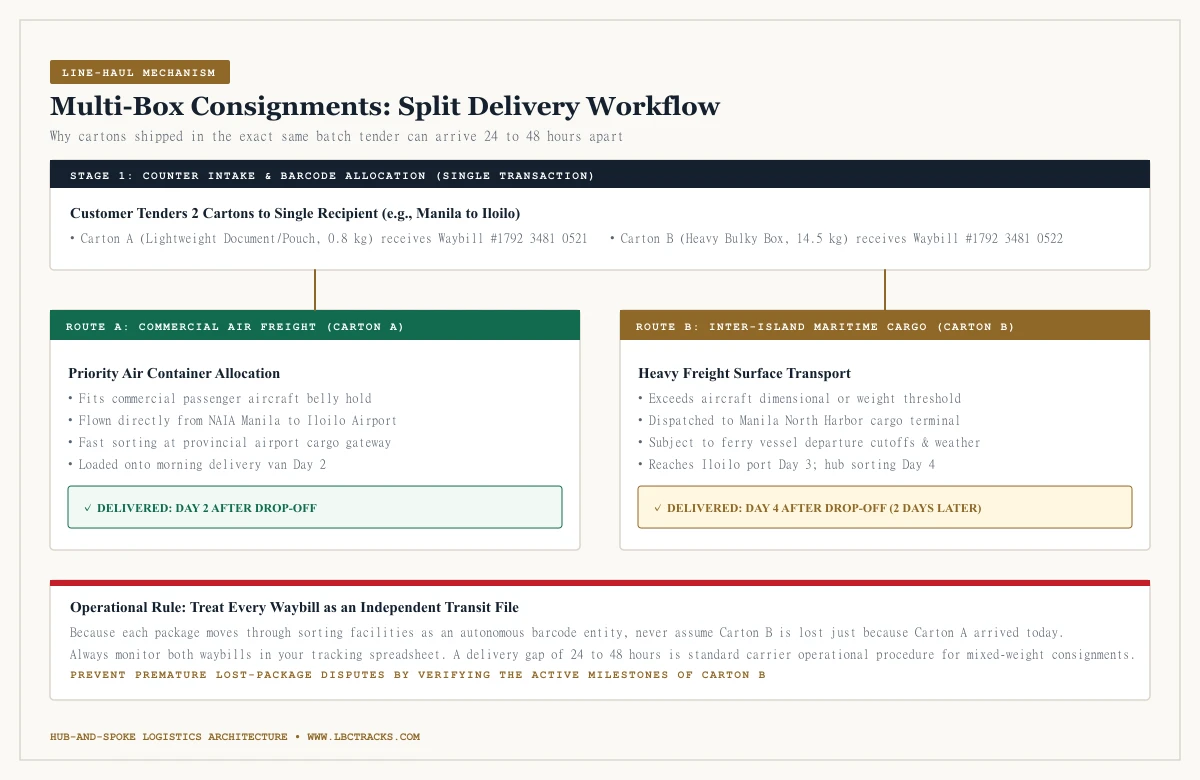
One of the most alarming scenarios for a customer waiting for a three-box order is opening the door to find the courier rider carrying only two boxes. Panicked calls immediately flood customer service with claims that "LBC lost my third package!"
In reality, this occurrence—known in logistics as a split delivery—is a standard byproduct of hub-and-spoke sorting optimization. Understanding the physical mechanics of split deliveries prevents unnecessary panic and dispute filing:
Volumetric and Weight Sorting at Distribution Gateways
When a multi-carton consignment arrives at a regional sorting gateway (such as the Central Exchange in Pasig or secondary hubs in Clark and Cebu), cartons pass through automated dimensioners and scales. Commercial passenger aircraft belly holds enforce strict maximum height, weight, and lithium-battery safety regulations. Lightweight cartons frequently travel via priority commercial air freight, while heavier, denser boxes are assigned to ground line-haul trailers and inter-island roll-on/roll-off (Ro-Ro) ferry vessels.
For example, on the Manila-to-Iloilo transit corridor, air cargo arrives at Iloilo Airport in under 90 minutes of flight time. Meanwhile, surface Ro-Ro cargo travels by highway through Batangas Port, boards an inter-island ferry across the Sibuyan Sea, and docks at Dumangas or Iloilo Port 36 to 48 hours later. If a single customer order contains both an air-eligible pouch and a heavy Kilobox Large, a 2-day delivery gap between the items is physically inevitable.
Maritime Ferry Delays and Gale Warning Suspensions
In an island nation subject to an average of twenty tropical cyclones annually, maritime transit corridors are uniquely vulnerable to sea weather disruptions. When the Philippine Atmospheric, Geophysical and Astronomical Services Administration (PAGASA) issues Public Storm Warning Signals, the Philippine Coast Guard (PCG) immediately suspends sea vessel departures.
While air-freighted packages continue moving between operational airports, maritime freight trucks remain parked at ports in Batangas, Matnog, or Allen. Consequently, cartons from the same batch routed via sea transport will experience unavoidable holding intervals until sea lanes safely reopen.
Feeder Van Space Allocation and Route Staging
Even when cartons arrive at the local delivery team depot on the same morning, delivery van capacity constraints come into play. A courier motorcycle or compact delivery van navigating narrow barangay streets can only carry a finite volume. If the driver cannot safely accommodate all three heavy cartons in a single run, the third carton is staged for the afternoon shuttle or the following morning dispatch.
Never assume a package is lost because items in a batch arrived on different days. Always query the specific 12-digit waybill of the outstanding carton on our tracking portal. If its status shows "Received at Delivery Hub" or "Staged for Delivery", the parcel is fully accounted for and moving through standard route queues.
Building and Operating a Master Consignment Tracking Ledger
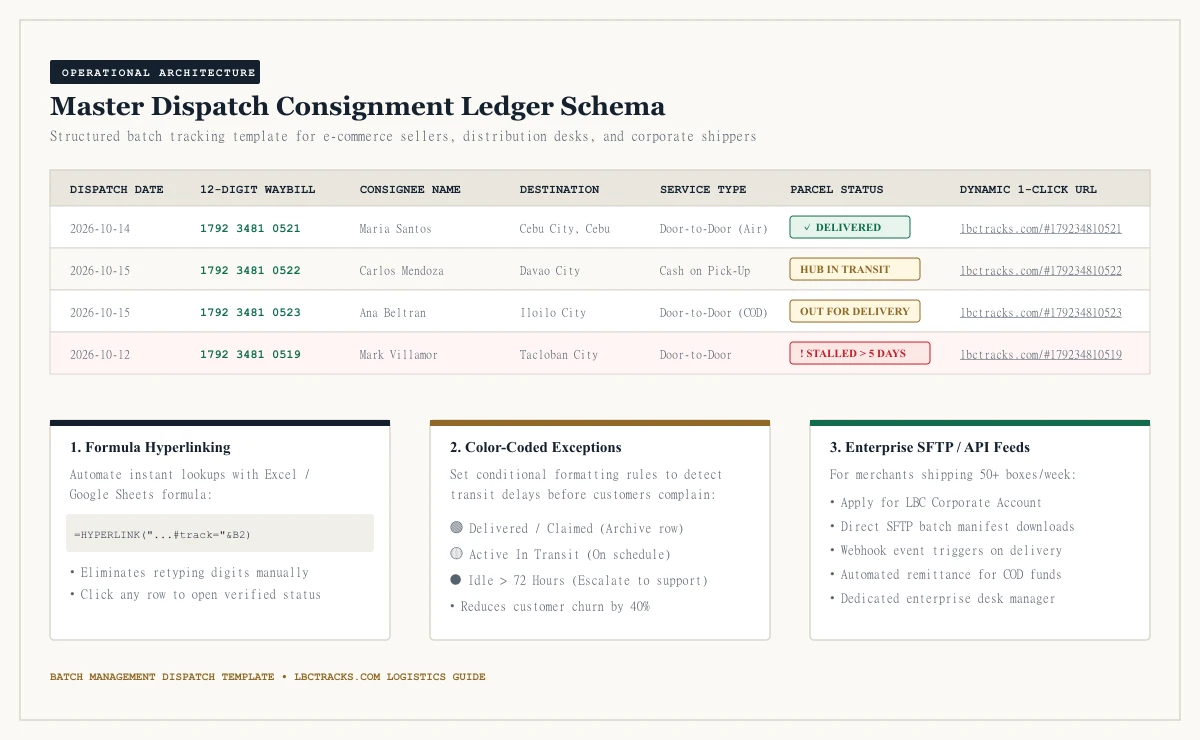
To liberate your business from manual tracking chaos, implement a standardized Master Consignment Tracking Ledger using Google Sheets, Microsoft Excel, or your enterprise order management system. A well-constructed ledger transforms chaotic receipts into an automated control tower.
Follow this 4-step implementation protocol to set up an institutional tracking ledger:
Establish Standardized Tracking Columns
Create a spreadsheet with the following mandatory columns: (A) Dispatch Date, (B) 12-Digit Waybill Number, (C) Consignee Full Name, (D) Contact Phone, (E) Destination City/Branch, (F) Service Category [Door-to-Door, COP, COD], (G) Declared Value, (H) Current Milestone Status, and (I) Direct Tracking Link.
Embed Dynamic 1-Click Tracking Formulas
Eliminate copying and retyping digits by embedding an automated hyperlink formula in Column I. In Google Sheets or Excel, use: =HYPERLINK("https://www.lbctracks.com/#track=" & B2, "Track " & B2). Clicking any cell instantly opens verified carrier status.
Configure Conditional Formatting Exception Alerts
Apply color rules to Column H based on delivery age: Green for "Delivered / Claimed", Yellow for "In Transit (Under 72 Hours)", and Red for "Stalled / No Scan (Over 72 Hours)". This highlights operational bottlenecks instantly.
Log Daily Counter Intake Slips Immediately
Input waybills into your master sheet within 60 minutes of counter tender. Keep physical thermal slips organized chronologically in a binder, or snap high-resolution photos and attach file links to the corresponding spreadsheet row.
Enterprise Solutions: Transitioning to LBC Corporate Accounts
When your shipping volume scales beyond 50 packages per week, managing individual retail counter visits and manual spreadsheet entries becomes inefficient. At this juncture, businesses should transition to LBC Business Solutions.
Opening an official corporate commercial shipping account unlocks enterprise logistics features that eliminate retail friction entirely:
- Scheduled On-Site Vehicle Pickups: Dedicated LBC cargo vans arrive directly at your warehouse, office, or fulfillment hub at scheduled daily hours, eliminating trips to retail branches.
- Bulk Electronic Waybill Printing: Generate hundreds of standardized thermal shipping labels directly from your desktop computer. Waybill barcodes are allocated electronically, allowing labels to be pre-printed and applied during packing.
- Automated Electronic Data Interchange (EDI): Download consolidated digital dispatch manifests in CSV or XML format. Instead of manual data entry, your order management software syncs tracking numbers automatically.
- Consolidated Billing and COD Remittance: Eliminate petty cash counter payments with monthly commercial invoicing. For Cash on Delivery (COD) and Cash on Pick-Up (COP) transactions, funds are remitted electronically into your corporate bank account via scheduled direct deposits.
- Dedicated Key Account Manager: Receive personalized operational escalation support, bypassing public customer care queues for priority investigation of stalled or damaged consignments.
- Automated Reverse Logistics Protocol: Return-to-Sender (RTS) parcels are consolidated and routed directly back to your central corporate facility on scheduled weekly runs, preventing lost returns at retail branches.
Qualifying for an LBC Business Account typically requires presenting valid DTI or SEC business registration documents, a Mayor's Business Permit, and BIR Certificate of Registration (Form 2303). Inquire at your nearest regional commercial sales office or via the official corporate portal.
Streamlining Customer Communications and Notification Pipelines
In e-commerce logistics, the volume of customer inquiries is directly correlated with tracking clarity. When buyers are left in the dark, they bombard your chat support with "Where is my item?" messages. Proactive batch communication eliminates this friction at the source.
To automate customer updates without purchasing expensive software, implement these best practices:
Accurate Intake Data Ensures Automated Carrier SMS
When tendering packages at the branch counter or through bulk booking software, ensure the recipient's 11-digit Philippine mobile phone number is encoded with 100% precision. LBC's automated transactional SMS gateway triggers automated dispatch notifications directly to the consignee's smartphone upon parcel sorting at the primary regional exchange. A single transposed digit breaks this automated communication loop.
Standardized Multi-Channel Dispatch Templates
Send an automated post-dispatch notification message via Viber, WhatsApp, or Facebook Messenger immediately following drop-off. Adapt this proven template:
- "Hello [Customer Name]! Your order #[Order Number] has been dispatched via LBC Express today. Your official 12-digit tracking number is [1792 3481 0521]. You can track your real-time delivery status here: https://www.lbctracks.com/#track=[179234810521]. Expected delivery turnaround is [2-4 business days]. Please note that initial origin branch sorting scans typically register online within 2 to 6 hours. Thank you for your support!"
Common Batch Tracking Hazards and How to Avoid Them
Managing dozens of active shipments simultaneously introduces operational risks. Avoid these common batch logistics mistakes:
- Pasting Multiple Codes into Single Search Bars: As established, public tracking websites cannot parse comma-separated lists. Use your hyperlinked master spreadsheet to open each consignment in an individual tab cleanly.
- Assuming Delayed Batches Mean Lost Packages: Weather disturbances, inter-island ferry cancellations during tropical depressions, and port container congestion in Manila can delay an entire regional batch by 48 hours. Check regional travel advisories before escalating claims.
- Failing to Archive Thermal Slips: Digital spreadsheets are vital, but original paper thermal slips are legally required if you must file a formal loss or damage claim under declared value insurance terms. File physical receipts by dispatch week in protective folders.
- Neglecting COD Aging Reports: Cash on Delivery parcels held at delivery hubs tie up your working capital. Review your tracking ledger weekly to identify uncollected COP or failed COD drops, and contact buyers proactively to encourage claiming.
- Failing to Monitor 5-Day Branch Storage Windows: LBC branches hold failed deliveries and COP parcels for five (5) business days before initiating Return to Sender. If a customer fails to claim within 72 hours, trigger an automated phone call or reminder text.