The Surge in Courier Impersonation Fraud Across the Philippines
The rapid explosion of e-commerce across the Philippines has transformed online shopping from an occasional novelty into an indispensable daily routine. Millions of Filipino households now receive regular courier deliveries containing everything from clothing and personal electronics to fresh produce and prescription medicines. However, this high volume of daily parcel traffic has created a fertile hunting ground for sophisticated cybercriminal syndicates.
Because consumers expect parcel deliveries almost weekly, cybercriminals exploit this subconscious anticipation through social engineering. Scammers weaponize the brand reputation of the country's largest logistics carrier—LBC Express—to blast millions of fraudulent SMS text messages and social media solicitations. These scams do not rely on breaching complex mainframe security; instead, they manipulate human urgency, fear of missed deliveries, and trust in familiar logistics branding.
The enactment of the SIM Registration Act (Republic Act No. 11934) aimed to curb text-based fraud by mandating identity verification for all mobile subscribers. However, organized crime groups have adapted by acquiring pre-registered SIM cards registered under fictitious identities or identity theft victims, deploying illegal GSM gateway routers (colloquially known as "SIM boxes"), and rotating prepaid SIM cards across automated SMS broadcasting rigs. As a result, courier-themed smishing remains one of the top cybercrime categories reported to the Cybercrime Investigation and Coordinating Center (CICC).
Understanding how these criminal operations function, recognizing the red flags of counterfeit waybills, and enforcing strict household delivery protocols is essential to safeguarding your personal identity and financial accounts.
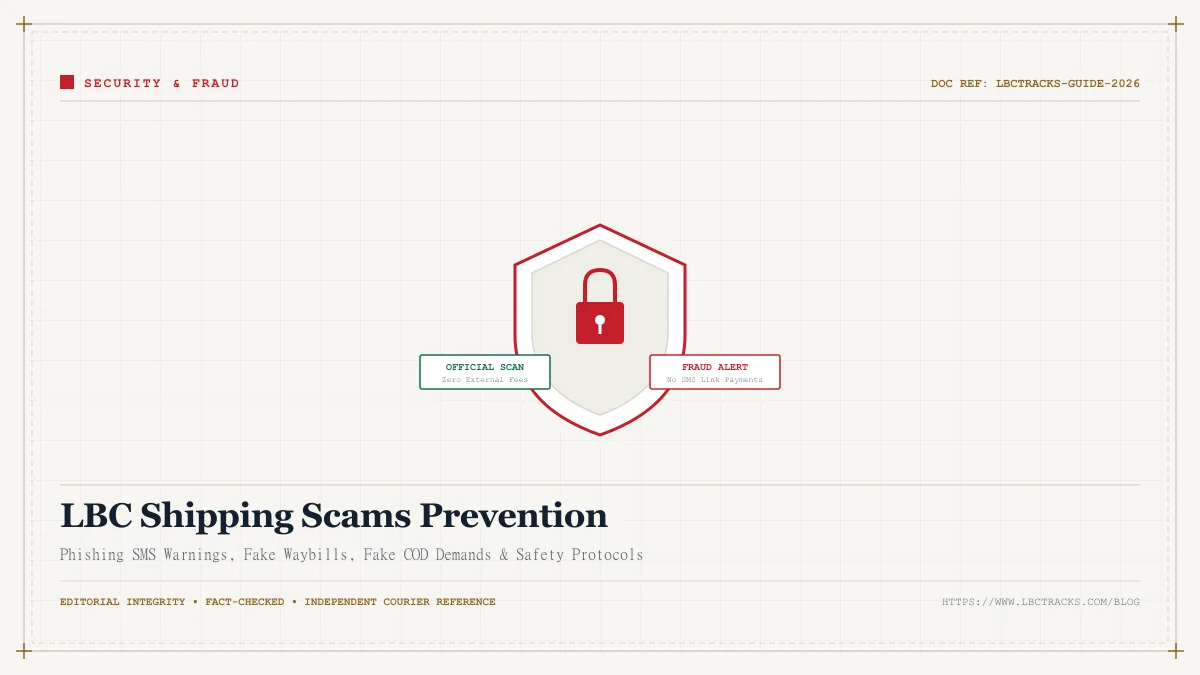
LBC Express NEVER sends clickable hyperlinks via SMS requiring payment of redelivery fees, customs clearance charges, or address modification fees. All legitimate courier fee adjustments occur exclusively in person at physical retail branch counters.
Scheme 1: The "Undelivered Parcel / Address Update" Smishing SMS
The most prevalent courier fraud in the Philippines is SMS phishing, commonly termed smishing. In this scheme, automated computer modems blast bulk text messages to thousands of random Philippine mobile numbers (Globe, Smart, and DITO networks). Even with the implementation of the SIM Registration Act (Republic Act No. 11934), criminal rings utilize foreign virtual numbers, spoofed sender headers, and illegally registered SIM cards to send fraudulent notifications.
When an unsuspecting victim taps the hyperlink, their browser loads a cloned lookalike webpage that mimics LBC's official visual design, complete with corporate logos, red-and-white color schemes, and simulated tracking maps. The site prompts the user to "correct" their address, followed by a simulated checkout gateway requesting credit card numbers, expiration dates, three-digit CVV security codes, or GCash/Maya login credentials.
The moment the victim submits their card information, the criminal backend immediately attempts an unauthorized high-value online transaction (often on international gambling or cryptocurrency platforms). The fraudulent site displays a secondary screen prompting for the One-Time Password (OTP) sent to the victim's phone. If the victim enters the OTP, their bank account is drained within seconds.
- "LBC Express Alert: Your parcel #PH-98214-X cannot be delivered due to incomplete street address. Please update your delivery details within 12 hours at https://lbc-parcel-redelivery-ph.com/update to avoid return to sender. A PHP 48.50 redelivery fee applies."
Scheme 2: Unsolicited Cash on Delivery (COD) Parcels: The Doorstep Trap
While smishing targets digital credentials, the Unsolicited Cash on Delivery (COD) scam—often referred to globally as "brushing" fraud—unfolds physically right at your front door. This scheme relies on leaked e-commerce consumer databases containing names, physical addresses, and mobile numbers obtained from discarded shipping labels or rogue third-party merchant lists.
The mechanics of the doorstep trap follow a calculated psychological script:
Scammers Dispatch Low-Value Goods via Real Courier Networks
A syndicate packages worthless items—such as dirt, bar soap, broken costume jewelry, or expired cosmetics—into a standard courier pouch, declaring a COD collection amount between PHP 600 and PHP 1,800.
Timing Delivery During Work or School Hours
The legitimate courier rider arrives at the residential address when the primary online shopper is away at the office or school, greeting elderly parents, domestic helpers, or teenage siblings.
Exploiting Household Assumptions to Collect Cash
The rider announces: "Delivery for Ma'am Maria, COD amount PHP 1,250." Family members assume the resident made an online purchase and forgot to mention it. Not wanting the delivery to fail, they pay cash out of household funds.
Discovery of the Fraud After the Courier Leaves
When the true recipient comes home and opens the box, they discover worthless junk. Because the delivery was completed and signed, the courier cannot issue an immediate on-the-spot cash refund.
Establish an unbreakable household rule: Never pay for an unexpected COD package without calling the buyer first. If the intended recipient cannot be reached by phone to confirm the order, instruct household members to tell the rider to attempt delivery the next day.
Scheme 3: Counterfeit Social Seller Waybills on Facebook & Instagram

Online commerce in the Philippines thrives outside regulated marketplaces. Thousands of independent social sellers operate on Facebook Marketplace, Instagram, Carousell, and Viber groups. While most sellers are legitimate, unscrupulous scammers use courier documentation as visual bait to steal advance payments.
In this scenario, a buyer agrees to purchase a high-value item (such as a second-hand camera, smartphone, or collectible sneakers). The seller insists on full payment via GCash or bank transfer before shipping. When the buyer hesitates, the seller sends a photo of an official LBC paper receipt showing the buyer's exact name and address, claiming: "I already dropped off your box at the branch! Send payment now so I can send you the tracking updates."
In reality, the receipt is a complete graphic counterfeit fabricated in mobile photo editing apps or printed on a portable thermal printer using downloaded template fonts. To spot a counterfeit waybill slip, look for these five forensic telltales:
- 1. The Barcode Scanner Test: Use a free smartphone barcode scanner app to scan the linear 1D barcode on the image. On a fake receipt, the barcode either fails to decode or decodes into random gibberish that does not match the printed 12-digit number.
- 2. Typography & Font Mismatches: Authentic LBC branch thermal printers generate a uniform dot-matrix or thermal raster font. Counterfeit receipts feature unnaturally crisp, vector-sharp text, mismatched font weights, or uneven digital baseline alignments.
- 3. Missing Branch POS Machine Identifiers: Genuine thermal receipts display the unique Branch Code, Register Terminal Number, Cashier ID, and a matching transaction timestamp down to the second.
- 4. Incorrect Waybill Digit Length: Standard domestic LBC express waybill numbers follow a strict 12-digit numeric structure. Fake receipts generated by foreign scammers frequently display 10-digit, 14-digit, or alphanumeric sequences.
- 5. Immediate Tracking Portal Verification: Enter the 12-digit code into an independent tracking portal. A genuine branch drop-off registers an "Accepted at Branch" status within 15 to 30 minutes of counter intake.
Scheme 4: The Fake "Customs Clearance Fee" Balikbayan Scam
A particularly predatory fraud targets the families of Overseas Filipino Workers (OFWs) residing in the Middle East, North America, Europe, or East Asia. Scammers monitor public social media posts where families celebrate relatives sending Balikbayan boxes or overseas care packages.
The victim receives an official-sounding phone call or text message from someone impersonating an LBC logistics officer or a Bureau of Customs (BOC) clearance agent. The caller claims that a high-value Balikbayan box or international express package sent from abroad has been impounded at the Ninoy Aquino International Airport (NAIA) air cargo terminal or Manila International Container Terminal (MICT) due to undeclared luxury items, jewelry, or foreign currency.
The scammer threatens that the box will be confiscated and the sender abroad arrested unless the recipient immediately wires an emergency "Customs Clearance Fee" or "Diplomatic Inspection Tariff" of PHP 5,000 to PHP 25,000 to a personal GCash or bank account. In reality, legitimate courier customs clearance fees are billed on formal company letterhead and settled directly at official branch counters, never through personal e-wallet accounts.
Under Philippine customs law (Customs Modernization and Tariff Act, RA 10863), bona fide OFWs sending personal effects and household goods valued under PHP 150,000 are legally entitled to tax and duty exemption up to three times per calendar year. Furthermore, legitimate customs assessments are accompanied by an official Bureau of Customs Assessment Form (BCOR) and an official billing statement from LBC's designated customs brokerage division. The Bureau of Customs never instructs courier recipients to transfer money to personal mobile numbers or private bank accounts.
How to Verify Authentic LBC Waybill Numbers and SMS Senders
Distinguishing between a legitimate courier alert and a criminal phishing attempt requires applying consistent verification habits. Senders and recipients should bookmark these operational rules:
- Authentic SMS Sender Headers: Under National Telecommunications Commission (NTC) regulations, enterprise corporations utilize approved Alphanumeric Sender IDs (masks) like
LBCorLBCExpress. Phishing text messages almost universally originate from random 11-digit domestic mobile numbers (e.g., 0917-XXX-XXXX, 0968-XXX-XXXX) or foreign country codes (+44, +1, +63). - Check the Hyperlink Domain: Authentic LBC web assets reside exclusively under the official corporate domain:
lbcexpress.com. Phishing websites use hyphenated, deceptive domains such aslbc-parcel-tracking.com,lbc-delivery-ph.top, orph-lbc-express.live. - Verify on Independent Tracking Tools: Never click the link inside an SMS to check your package. Open your web browser independently, navigate to a verified tracking tool, and input the 12-digit number manually.
Emergency Response: What to Do If You Clicked a Link or Paid a Scam
If you inadvertently clicked a suspicious link, entered your credit card details, or paid an unsolicited COD parcel, immediate and aggressive containment is critical to minimizing financial damage:
Immediately Lock or Block Payment Cards via Banking Apps
Open your mobile banking application (BDO, BPI, UnionBank, Metrobank) and activate the temporary card lock feature. If your card does not support in-app locking, call your bank's emergency hotline to cancel the card and request re-issuance.
Report Compromised E-Wallets (GCash / Maya) Within the Golden Hour
If you shared an OTP or sent funds via GCash or Maya, immediately lodge an in-app dispute ticket and call their customer hotline. Rapid reporting increases the chance that compliance teams can freeze the receiving scammer wallet.
Execute Formal Chargeback and Fraud Affidavits Under BSP Regulations
Under Bangko Sentral ng Pilipinas (BSP) Consumer Protection Regulations (Circular No. 1160), cardholders who report unauthorized online card transactions are entitled to file a formal Affidavit of Dispute / Fraud Chargeback. Request temporary provisional credit while the issuing bank investigates the fraudulent merchant transaction.
Change Digital Banking Passwords and Enable Biometrics
From a secure, secondary device, change passwords on all email accounts and financial apps. Revoke active browser sessions and enable multi-factor authentication (MFA) using app-based authenticators instead of SMS.
Preserve Full Digital Evidence for Law Enforcement
Capture full-screen screenshots of the phishing SMS, sender phone number, browser URL bar, fraudulent payment receipts, and conversation logs. Do not delete the text message.
Official Government and Law Enforcement Reporting Channels
Reporting cybercrime and courier fraud contributes to the takedown of malicious domain servers, the deactivation of criminal bank accounts, and the prosecution of syndicates under Republic Act No. 10175 (Cybercrime Prevention Act of 2012). Senders and consumers should report all incidents to verified authorities:
| Agency / Organization | Contact Channel | Function / Scope |
|---|---|---|
| Cybercrime Investigation and Coordinating Center (CICC) | Inter-Agency Hotline 1326 / cicc.gov.ph | Central 24/7 national hotline for immediate scam reporting and domain takedowns |
| PNP Anti-Cybercrime Group (PNP-ACG) | Hotline: (02) 8414-1560 / acg.pnp.gov.ph | Filing formal criminal complaints, investigative subpoenas, and cybercrime prosecution |
| NBI Cybercrime Division (NBI-CCD) | cd@nbi.gov.ph / (02) 8523-8231 | Investigating complex cyber syndicates, financial phishing rings, and identity theft |
| National Telecommunications Commission (NTC) | consumer@ntc.gov.ph / ntc.gov.ph | Reporting malicious mobile numbers sending spam and smishing texts for SIM blocking |
| LBC Express Corporate Fraud Desk | customercare@lbcexpress.com / (02) 8858-5999 | Internal security investigation and blacklisting of fraudulent accounts |