The Anatomy of Counterfeit and Manipulated LBC Shipping Slips
To protect yourself from shipping fraud, you must understand the visual and technical indicators of a forged LBC receipt. Scammers typically employ three common forgery tactics:
Photoshop Font and Kerning Discrepancies
Genuine LBC thermal POS printers use standardized monospaced, dot-matrix, or fixed-pitch system fonts. Scammers often erase the recipient details from an old receipt and type new text using standard Arial, Helvetica, or generic digital fonts. Look closely at the recipient name and address: if the font sharpness, resolution, or baseline angle looks noticeably crisper or misaligned compared to the surrounding faded thermal paper, the image is altered.
Additionally, thermal printers print with distinctive horizontal microscopic banding caused by heating pins. Forged digital text inserted into a photograph lacks this micro-texture, appearing unnaturally flat and razor-sharp against the grain of the paper.
The Promotional 2D QR Code Trap
A widespread deception tactic involves scammers pointing to the square 2D QR code printed at the bottom of modern thermal slips, claiming: "Scan this QR code, it proves the package is in transit!" In reality, as detailed in our guide on tracking without a receipt, this QR code is purely promotional and contains a static URL linking to the LBC mobile app download page. It contains zero consignment data, no waybill number, and no delivery status.
Recycled Waybill Codes from Unrelated Shipments
Sophisticated scammers actually ship an item—such as an empty document pouch to an accomplice in another city—and send the genuine tracking number to multiple buyers simultaneously. While the number returns a real status on the carrier tracker, the destination hub is completely wrong.
The Three-Point Consignment Verification Protocol
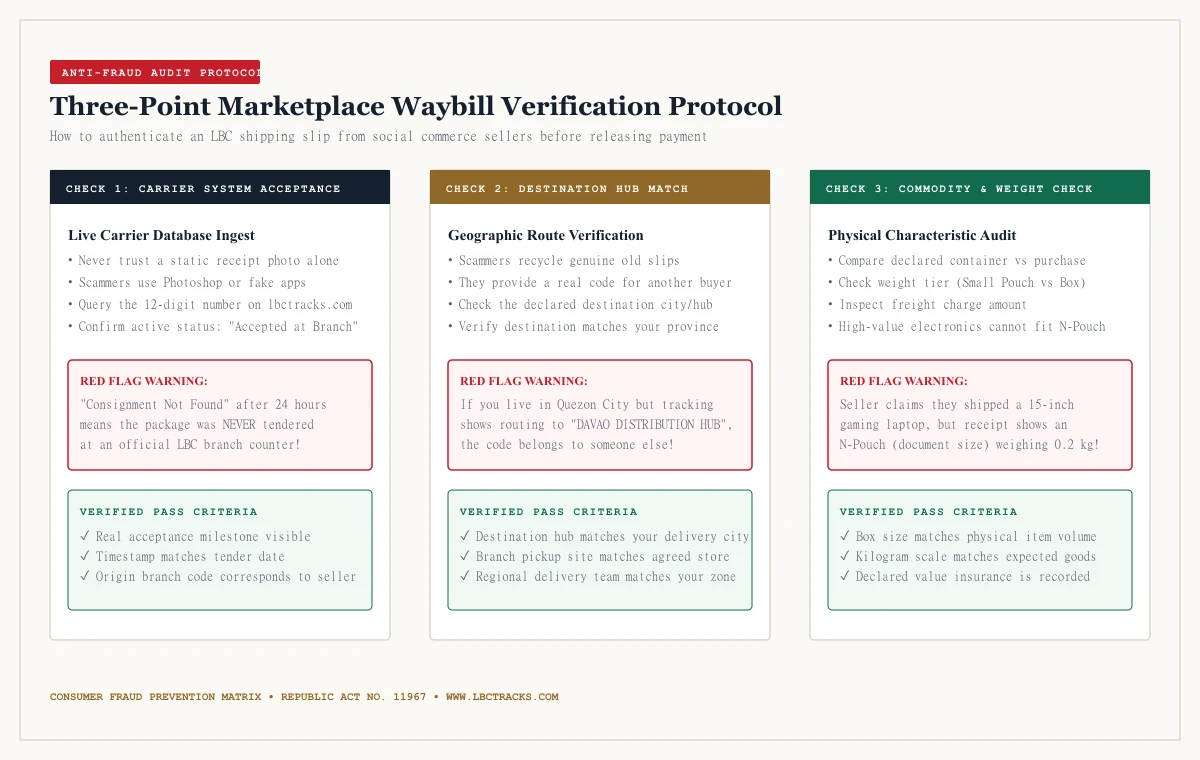
Before you release payment or accept a delivery, execute this rigorous Three-Point Consignment Verification Protocol using an independent tracking lookup tool:
Point 1: Confirm Live Carrier System Acceptance Scan
Type the 12-digit number into our tracking tool. Confirm that a verified status appears, such as "Accepted at Origin Branch" or "Received at Sorting Hub". If the system returns "Consignment Not Found" after 6 to 12 hours, the physical parcel was never tendered at an official branch counter.
Point 2: Verify Destination Municipality and Hub Match
Inspect the destination delivery hub displayed on the tracking screen. If you live in Quezon City or Pasig, but the tracking record shows routing to "DAVAO REGIONAL DISTRIBUTION HUB" or "CEBU CENTRAL EXCHANGE", the seller provided another customer's tracking code.
Point 3: Align Package Classification and Volumetric Weight
Check the package size and weight tier recorded on the shipping label. If you purchased a heavy pair of running shoes or a gaming console, but the receipt shows an "N-Pouch" weighing 0.2 kg with a minimal ₱95 freight charge, you are being sent an empty pouch or cardboard dummy.
The Payment Protection Hierarchy for Social Commerce
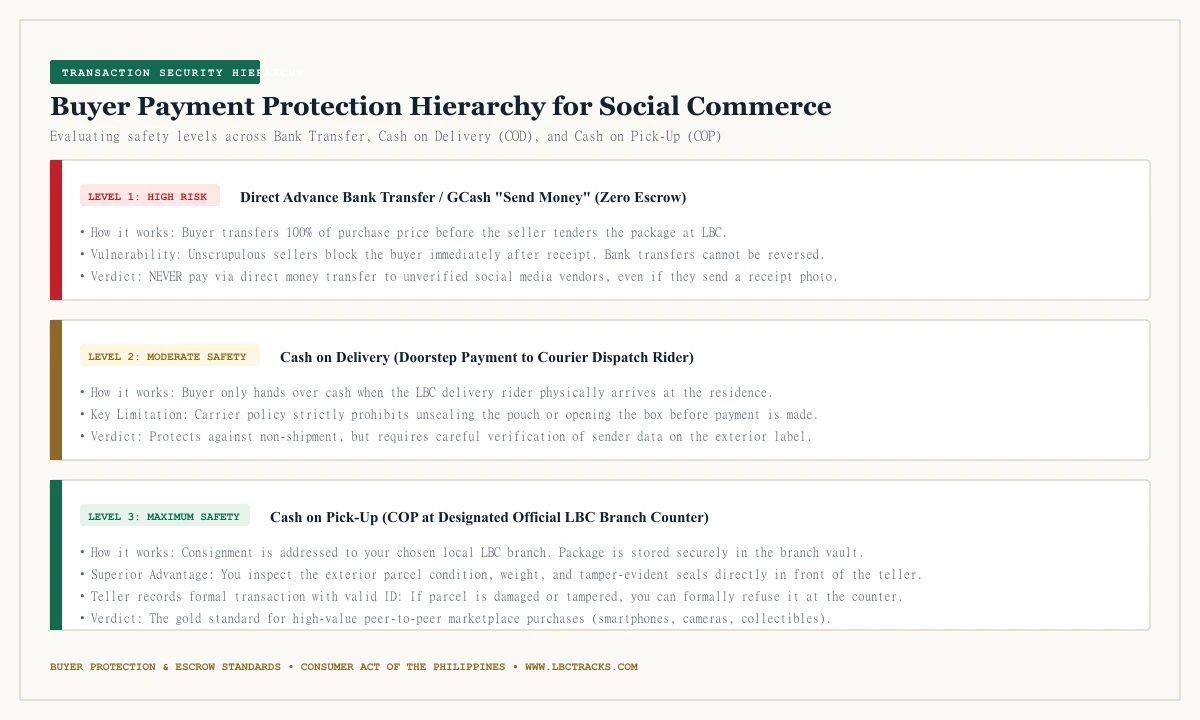
How you settle shipping transactions determines your financial exposure. Always assess marketplace payment methods according to the Payment Protection Hierarchy:
| Transaction Method | Payment Timing | Physical Inspection Permitted? | Scam Risk Level |
|---|---|---|---|
| Advance Bank / GCash Transfer | Before seller drops off parcel | NO — Money sent with zero verification | CRITICAL — 100% loss if seller ghosts or sends empty box |
| Cash on Delivery (COD) Home Delivery | At doorstep upon rider arrival | Exterior only — Unsealing forbidden before payment | MODERATE — Guarantees arrival, but interior items uninspected |
| Cash on Pick-Up (COP) Branch Counter | At branch teller counter | Exterior & weight under branch security cameras | LOWEST / SAFEST — Can reject delivery at counter before payment |
Level 1: Direct Bank Transfer / GCash "Send Money" (Highest Risk)
Transferring funds directly to a seller's personal bank account or GCash wallet before receiving the item carries extreme risk. Once funds are transferred via peer-to-peer payment rails, the transaction is irreversible. If the seller blocks your account or sends an empty box, financial institutions cannot reverse the charge without a formal court order or lengthy police investigation.
Level 2: Cash on Delivery (COD) Doorstep Delivery (Moderate Safety)
With Cash on Delivery, you only hand cash to the LBC dispatch rider when they physically arrive at your residence. This protects you against total non-shipment. However, because carrier policy prohibits breaking parcel seals before payment, unscrupulous sellers can still ship substandard or broken items inside sealed pouches.
Level 3: Cash on Pick-Up (COP) at Official LBC Branch (Gold Standard)
For high-value peer-to-peer marketplace purchases (smartphones, cameras, luxury goods, laptops), Cash on Pick-Up (COP) at an official LBC branch counter provides the highest safety. The package is delivered to your designated local LBC branch. You inspect the exterior parcel condition, weight, and tamper-evident seals under the branch security cameras in front of the teller before paying. If the parcel appears tampered or suspicious, you can formally refuse it at the counter without losing your money.
Furthermore, the branch teller records the claimant's valid government ID during handover, creating an official, auditable chain of custody. This verified environment virtually eliminates the possibility of hit-and-run counterfeit parcel swaps.
Legal Framework & Consumer Protection Under Philippine Law
Victims of social commerce fraud are protected by extensive Philippine legislation. If a seller defrauds you using fake tracking slips or deceptive shipping claims, the following legal statutes apply:
- Republic Act No. 7394 (The Consumer Act of the Philippines): Prohibits deceptive, unfair, and unconscionable sales acts or practices. Enforced by the Department of Trade and Industry (DTI), the law mandates accurate representations of goods and penalizes fraudulent trade conduct.
- Republic Act No. 11967 (The Internet Transactions Act of 2023): Establishes the E-Commerce Bureau under the DTI, requiring online merchants, digital marketplaces, and e-retailers to maintain verifiable commercial records. The law establishes an online dispute resolution mechanism and empowers the DTI to issue takedown orders against fraudulent merchants.
- Article 315 of the Revised Penal Code (Swindling / Estafa): Any individual who defrauds another by means of false pretenses, fraudulent representations, or simulated business transactions is criminally liable for Estafa, punishable by imprisonment.
- Republic Act No. 10175 (Cybercrime Prevention Act of 2012): When Estafa or identity fraud is committed through internet communications, social media platforms, or electronic messaging, penalties are elevated by one degree under cybercrime enhancement clauses.
Emergency Action Protocol: What to Do If You Suspect a Scam
If you sent money for a marketplace order and discover that the seller provided a forged tracking slip or blocked your messages, take immediate action within the first 1 to 2 hours:
Report Transaction to GCash / Maya Anti-Fraud Desk
Submit an immediate ticket on the payment app's Help Center citing "Scam / Fraudulent Merchant". Provide the transaction reference number, recipient mobile number, and screenshots of the fake tracking receipt to request that the scammer's e-wallet account be frozen.
Contact LBC Customer Support with the Waybill Number
Call LBC hotline support or visit your nearest branch. Provide the 12-digit waybill. If the parcel is an active uncollected COD/COP shipment or if the number belongs to an ongoing fraud scheme, customer care can flag the tracking record in internal dispatch registers.
Preserve Complete Digital Evidence Trails
Take high-resolution screenshots of the seller's social media profile, URL link, full chat transcript, item listing photo, payment confirmation, and the forged tracking receipt before the scammer deletes the conversation or deactivates their account.
File an Official Complaint with PNP-ACG or NBI Cybercrime
Submit an online complaint with the Philippine National Police Anti-Cybercrime Group (PNP-ACG) at acg.pnp.gov.ph or the National Bureau of Investigation (NBI) Cybercrime Division. Bring printed evidence copies for formal affidavit preparation.
Best Practices for Safe Online Buying from Independent Sellers
To enjoy the bargain prices of social commerce without becoming a fraud statistic, adopt these institutional purchasing disciplines:
- Demand Cash on Pick-Up (COP) for Any Item Exceeding ₱1,500: Legitimate sellers will gladly agree to COP because LBC remits their cash directly once claimed. Scammers will aggressively make excuses to avoid COP.
- Request "Proof of Packaging" with Specific Identifiers: Ask the seller to send a short video holding the item next to a piece of paper displaying today's date, your name, and their handwritten signature.
- Audit Seller Account Age and Community Trade References: Inspect the seller's Facebook or Instagram profile. Profiles created within the past 6 months, accounts with locked profile photos, or listings with disabled comments are major red flags.
- Never Be Rushed by "Limited Time" Pressure: Scammers create artificial urgency (e.g., "Someone else is offering higher, pay now or I ship to them") to prevent buyers from executing proper waybill verification.
The Vulnerability of Social Commerce in the Philippines
The growth of social commerce in the Philippines has made peer-to-peer shopping easier than ever. Every hour, thousands of pre-loved smartphones, designer clothes, collectible toys, mechanical keyboards, and automotive parts change hands on Facebook Marketplace, Instagram shopping boutiques, TikTok Shop off-app deals, Carousell, and private Viber trade communities.
However, unlike managed e-commerce platforms (such as Shopee or Lazada) that safeguard buyer funds in escrow accounts until delivery is confirmed, unmanaged social commerce operates without built-in buyer protection. Transactions rely almost entirely on mutual trust between strangers.
Because LBC Express is the most recognizable and trusted courier brand in the Philippines, fraudulent online sellers frequently exploit carrier brand equity. Scammers tender empty envelopes, fabricate counterfeit receipt images using graphics software, or recycle real tracking numbers from unrelated deliveries to trick buyers into transferring money via GCash or bank deposit before disappearing.
The asymmetry of risk in peer-to-peer online shopping heavily disfavors the buyer. Once money is sent through non-custodial e-wallets or bank transfers, retrieving the funds without extensive legal action is nearly impossible. Implementing strict verification disciplines before parting with cash is your only effective shield.
A photograph of a courier receipt is NEVER proof of delivery or shipment. High-quality photo editing applications allow scammers to alter names, addresses, and tracking digits in under two minutes. Only a live, verified milestone on an independent carrier tracking portal proves that a physical parcel was tendered.