The Dimensional Weight Formula Explained
Cargo aircraft and delivery vans are constrained by both weight and physical space. A box filled with feathers takes up as much aircraft room as a box filled with metal. To balance this, couriers use dimensional weight.
Official Formula for LBC Domestic Freight
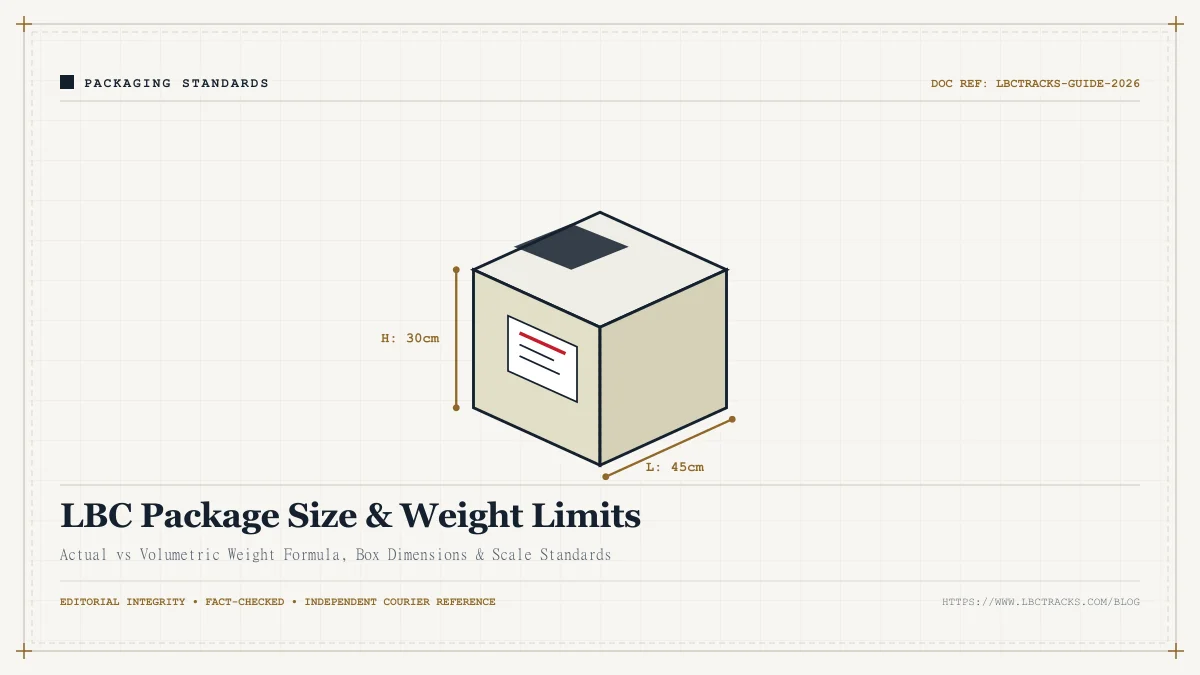
Volumetric Weight (kg) = [ Length (cm) × Width (cm) × Height (cm) ] ÷ 3,500 Example: A box measuring 40 cm × 30 cm × 25 cm has a cubic volume of 30,000 cm³. Dividing by 3,500 yields 8.57 kg. If its scale weight is only 3.0 kg, you are billed for 9.0 kg (rounded up).
Comparison: Actual Weight vs Volumetric Weight
See how different everyday items are billed at branch counters:
| Item Description | Box Dimensions (cm) | Actual Weight | Volumetric Weight (÷3500) | Billed Weight |
|---|---|---|---|---|
| Textbooks (Dense) | 30 × 20 × 15 cm | 7.5 kg | 2.57 kg | 7.5 kg (Actual) |
| Stuffed Plush Bear (Bulky) | 50 × 40 × 30 cm | 1.2 kg | 17.14 kg | 17.5 kg (Volumetric) |
| Footwear in Shoebox | 34 × 22 × 13 cm | 1.1 kg | 2.77 kg | 3.0 kg (Volumetric) |
| Metal Cookware Set | 40 × 35 × 25 cm | 9.0 kg | 10.0 kg | 10.0 kg (Volumetric) |
Practical Tips to Avoid Bulky Surcharges
Choose a box that closely hugs your items. Avoid using oversized boxes filled with excess crumpled newspaper, as empty volume directly increases your freight bill.