The Four Core Pillars of LBC Domestic Shipping Rates
Whether you are an independent e-commerce merchant shipping dozens of packages daily or an individual sending personal gifts or urgent documents to family in the provinces, estimating your shipping budget accurately is essential. Courier freight rates across the Philippines are not arbitrary figures; they follow a deterministic logistics pricing matrix governed by national transport economics.
At an LBC retail branch counter, four foundational variables interact to produce your final shipping invoice:
- 1. Packaging Classification (Pouch vs. Box): Standard courier pouches are billed under a streamlined flat-rate model based on the pouch size selected, provided the contents fit without over-stretching. Corrugated boxes, by contrast, are billed according to weight and dimensional volume.
- 2. Origin-to-Destination Geographic Zone: Shipping within the same city or metropolitan district costs significantly less than shipping across maritime straits. LBC classifies deliveries into distinct regional pricing bands: Intra-Region (such as within Metro Manila), Luzon-to-Luzon, Luzon-to-Visayas, Luzon-to-Mindanao, and Island-to-Island.
- 3. Chargeable Weight Assessment: For boxed shipments, freight tellers compare actual physical scale weight against volumetric dimensional weight (calculated using the domestic cargo formula). The customer is billed on whichever value is higher.
- 4. Value-Added Service Surcharges: Optional or mandatory auxiliary services—including declared value transit insurance, Cash on Delivery (COD) collection fees, specialized wood crating, or Out-of-Delivery Area (ODA) forwarding fees—are added to base freight tariffs.
Because moving freight between Philippine islands requires multimodal coordination—involving container ships, roll-on/roll-off (RO-RO) ferries, commercial cargo aircraft, and provincial delivery vans—cross-island tariffs incorporate fuel surcharges and maritime port terminal handling fees.
Domestic Pouch Sizes, Dimensions and Typical Price Tiers

For lightweight retail products, apparel, flat documents, cosmetics, and compact accessories, LBC's standardized polyethylene document envelopes—known as N-Pack Pouches—represent the most economical, convenient shipping solution. Pouches offer flat-rate pricing based on their designated size category up to a specified maximum weight threshold.
Below is an overview of the four standard N-Pack pouch sizes and illustrative pricing across major Philippine delivery corridors:
| Pouch Format | Physical Dimensions | Weight Limit | Intra-Metro Manila | Manila to Visayas / Mindanao |
|---|---|---|---|---|
| N-Pack Slim (Document Sleeve) | 9.5" × 14" (Flat) | Up to 500 grams | PHP 85 - PHP 105 | PHP 120 - PHP 150 |
| N-Pack Small (Small Pouch) | 10" × 15" (Expanding) | Up to 1.0 kg | PHP 100 - PHP 125 | PHP 145 - PHP 185 |
| N-Pack Medium (Medium Pouch) | 12" × 18" (Expanding) | Up to 3.0 kg | PHP 150 - PHP 190 | PHP 215 - PHP 275 |
| N-Pack Large (Large Pouch) | 14" × 22" (Expanding) | Up to 5.0 kg | PHP 225 - PHP 270 | PHP 315 - PHP 395 |
A pouch qualifies for flat-rate pricing only if the self-adhesive tamper-evident flap can close flat along the designated sealing line without ripping, over-stretching, or turning the pouch into an irregular sphere. If an item bulges excessively, branch tellers are required by carrier policy to reclassify the consignment into a corrugated Kilobox, which triggers volumetric dimensional weight billing.
Standard Corrugated Box (Kilobox) Rates and Size Categories
Senders may also supply their own custom cardboard boxes (known as "Own Box" consignments). When using an own-box container, the branch associate measures the box dimensions with a certified measuring tape and weighs it on the digital floor scale to determine which price tier applies.
| Kilobox Category | Outer Dimensions (L × W × H) | Included Weight Tier | Typical Intra-NCR Rate | Typical Cross-Island Rate |
|---|---|---|---|---|
| KB Mini (Compact Carton) | 9" × 5" × 3" (23 × 13 × 8 cm) | Up to 1.5 kg | PHP 140 - PHP 175 | PHP 220 - PHP 285 |
| KB Slim (Laptop / Document Box) | 16" × 10" × 3" (41 × 25 × 8 cm) | Up to 2.5 kg | PHP 190 - PHP 235 | PHP 290 - PHP 370 |
| KB Small (Medium Parcel Box) | 12" × 10" × 5" (30 × 25 × 13 cm) | Up to 3.0 kg | PHP 220 - PHP 275 | PHP 340 - PHP 435 |
| KB Medium (Standard Retail Carton) | 14" × 11" × 7" (36 × 28 × 18 cm) | Up to 5.0 kg | PHP 320 - PHP 395 | PHP 490 - PHP 620 |
| KB Large (Heavy-Duty Carton) | 18" × 12" × 9" (46 × 30 × 23 cm) | Up to 10.0 kg | PHP 540 - PHP 670 | PHP 820 - PHP 1,050 |
| KB Extra Large (Bulk Inventory Carton) | 20" × 16" × 12" (51 × 41 × 30 cm) | Up to 20.0 kg | PHP 880 - PHP 1,120 | PHP 1,350 - PHP 1,750 |
Actual Weight vs. Volumetric Weight: The 3,500 Divisor Formula
Consider two real-world packaging examples evaluated at an LBC branch counter:
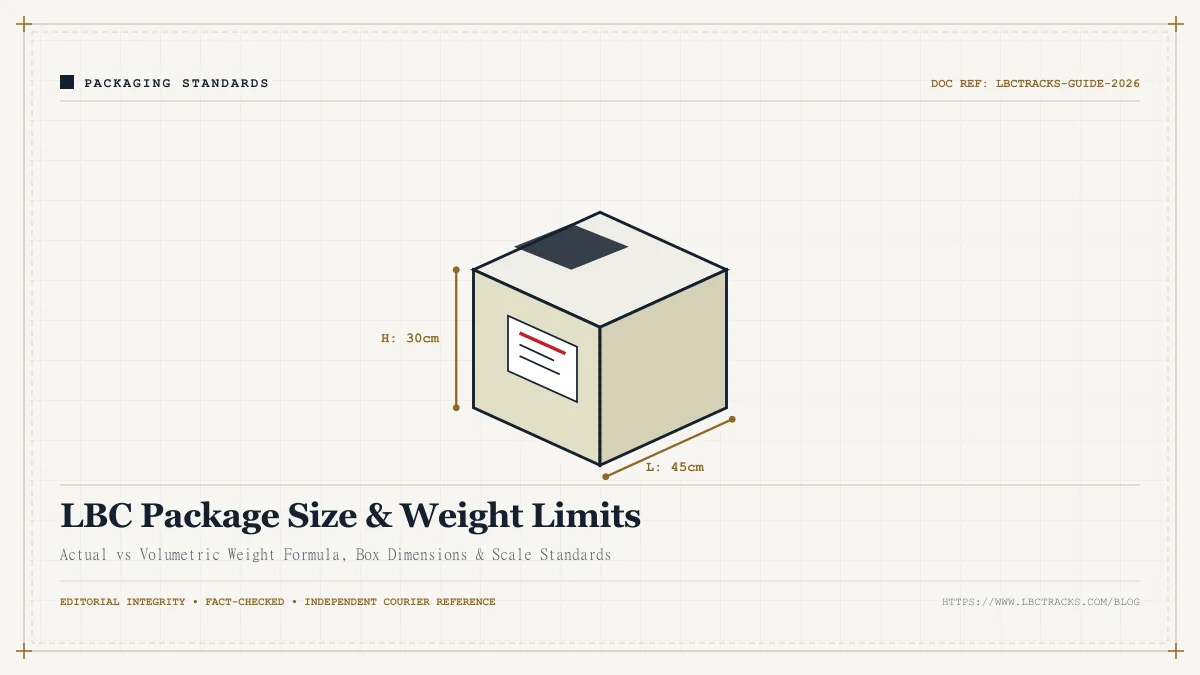
- Example A: Bulky Stuffed Plush Bear — The box measures 45 cm × 35 cm × 30 cm, resulting in a cubic volume of 47,250 cm³. Dividing by 3,500 gives a volumetric weight of 13.5 kg. However, the physical scale weight is only 1.8 kg. In this scenario, LBC bills the shipment based on the 13.5 kg volumetric tier (rounded to 14.0 kg).
- Example B: Set of Heavy Reference Textbooks — The box measures 30 cm × 20 cm × 15 cm (cubic volume: 9,000 cm³). Dividing by 3,500 yields 2.57 kg volumetric weight. However, on the digital scale, the dense books weigh 8.2 kg. Here, LBC bills based on the 8.2 kg actual scale weight (rounded to 8.5 kg).
Volumetric Weight (kg) = [ Length (cm) × Width (cm) × Height (cm) ] ÷ 3,500 Chargeable Weight = Greater of Actual Scale Weight vs. Volumetric Weight Note: In international air express logistics (DHL, FedEx), a 5,000 divisor is standard. In domestic Philippine ground and air cargo, 3,500 is the standard dimensional divisor applied across courier networks.
Valuation Surcharges and Carrier Insurance Coverage (RA 7394)
Every parcel tendered to a courier carries financial value. Under standard terms of carriage and Republic Act 7394 (Consumer Act of the Philippines), couriers provide baseline statutory liability coverage included in the standard freight charge (typically covering basic losses up to PHP 500 for small retail pouches).
If your shipment contains items of significant commercial or sentimental value—such as consumer electronics, mobile phones, designer jewelry, original legal deeds, or high-value merchandise—relying solely on baseline coverage exposes you to substantial financial loss if the parcel is damaged or lost during transit.
How Valuation Fees are Computed
For detailed guidance on documentation and claims procedures, consult our dedicated guide on filing LBC damaged or missing package claims.
- Valuation Fee Percentage: Typically 1% to 2% of the declared value exceeding the carrier's baseline liability tier.
- Minimum Valuation Fee: Most retail branches enforce a minimum valuation charge (typically PHP 15 to PHP 30 per consignment).
- Mandatory Proof of Value for High Declarations: For items declared above PHP 10,000 to PHP 20,000, branch tellers may request official sales invoices, retail receipts, or commercial appraisals to verify the declared amount and prevent fraudulent claims.
Cash on Delivery (COD) and Cash on Pick-Up (COP) Fee Structure
E-commerce in the Philippines is heavily driven by Cash on Delivery (COD) and Cash on Pick-Up (COP) fulfillment modes. These services allow buyers to inspect or pay for merchandise upon delivery or collection, significantly increasing sales conversions for online merchants. Because the courier must collect cash, safeguard currency, and execute electronic bank disbursements to the seller, an administrative handling fee is applied.
| Service Option | Primary Use Case | Typical Administrative Fee | Remittance Timeline |
|---|---|---|---|
| Cash on Delivery (COD) | Courier delivers to buyer's door and collects cash | 2.0% to 3.0% of collected amount (min. PHP 30 - PHP 50) | 3 to 5 business days via electronic bank transfer |
| Cash on Pick-Up (COP) | Buyer visits an LBC branch counter to pay and claim | 1.5% to 2.5% of collected amount (min. PHP 25 - PHP 40) | 2 to 4 business days via electronic bank transfer |
Cash on Pick-Up (COP) offers lower collection fees and significantly reduces delivery failure rates. When buyers collect at their local branch counter, sellers eliminate failed doorstep attempts caused by buyers being away from home or delivery riders being unable to access gated subdivisions.
Out-of-Delivery Area (ODA) Surcharges and Crating Costs
In addition to standard freight tariffs, two specialized operational surcharges occasionally apply depending on geographic destination and packaging requirements:
Out-of-Delivery Area (ODA) Surcharges
LBC operates over 1,500 company-owned retail branches and delivery hubs nationwide. However, certain isolated agricultural barangays, remote mountain settlements, and small offshore islands lie outside the standard daily courier van route. These destinations are designated as Out-of-Delivery Areas (ODA).
Delivering to an ODA zone requires forwarding the parcel to third-party local logistics contractors, arranging special motorcycle charters, or paying regional maritime ferry surcharges. ODA fees typically add an extra PHP 100 to PHP 350 to the base freight tariff. Senders shipping to remote towns can avoid ODA fees entirely by designating the nearest urban LBC branch as a "Branch Pick-Up" destination.
Protective Wood Crating for High-Risk Freight
When shipping large flat-panel television monitors, desktop computers, glass mirrors, musical instruments, or fragile vehicle components, standard cardboard boxes are vulnerable to crushing under heavy container stacks. For these items, carrier safety policy mandates professional wood crating.
LBC branches equipped with crating services construct custom timber slat crates around the corrugated box. Wood crating fees typically range from PHP 350 to upwards of PHP 1,200 depending on lumber volume, and the exterior dimensions of the crate become the final chargeable volumetric measurement.
Five Actionable Strategies to Lower Your LBC Freight Bill
Whether you are managing a small online shop or sending personal parcels, simple packaging and booking adjustments can significantly reduce your shipping expenses over time:
Select the Snuggest Box Size to Eliminate Wasted Volume
Never place compact merchandise into an oversized carton filled with crumpled newspaper. Because volumetric weight uses the 3,500 divisor, empty space directly inflates your bill. Cut down box corner flaps or select a Kilobox size that closely matches your merchandise dimensions.
Use Flexible Pouches Instead of Boxes for Soft Goods
Clothing, bedsheets, backpacks, plush fabrics, and apparel do not require rigid box protection. Compress them into an N-Pack Medium or Large pouch to take advantage of economical flat-rate pouch pricing rather than paying volumetric box tariffs.
Consolidate Multiple Orders for the Same Destination
Rather than shipping three separate small boxes to the same recipient, consolidate them into a single larger Kilobox or bundle them securely with shrink wrap. Consolidating avoids paying multiple base minimum freight charges.
Leverage Branch Pick-Up to Bypass Remote Area Surcharges
If your recipient lives in an outlying rural municipality, check whether they work near an urban commercial center. Shipping to an LBC branch for counter collection eliminates Out-of-Delivery Area (ODA) fees and ensures faster parcel retrieval.
Pre-Weigh and Measure Parcels Before Visiting the Branch
Weigh your package on a kitchen or luggage scale and measure length, width, and height with a tape measure at home. Calculating your estimated chargeable weight beforehand prevents unexpected billing surprises at the counter and helps you choose the most cost-effective packaging tier.