Understanding Return to Sender (RTS): What the Status Means
Finding the phrase "Return to Sender" or the acronym "RTS" on your LBC tracking screen marks a definitive pivot in a parcel's logistics journey. For buyers and recipients eagerly anticipating a package, it signals that normal delivery efforts have officially concluded and the item is no longer heading toward their doorstep. For merchants and personal shippers, it represents the activation of reverse logistics—an operational pipeline designed to bring unfulfilled freight safely back to its point of origin.
In express parcel logistics across the Philippine archipelago, "Return to Sender" is not an arbitrary carrier decision. Couriers operate on strict contractual service obligations under Philippine common carrier statutes (Civil Code Articles 1732 to 1766). An LBC delivery rider or provincial hub cannot simply mark a parcel for return on a whim; RTS is an automated protocol triggered only when delivery becomes operationally impossible or legally unviable under the carrier's published terms and conditions.
Once an RTS status is registered in the central tracking database, the parcel's routing barcode is electronically re-indexed. The original delivery destination is wiped from the active dispatch manifest, and the originating branch where the sender originally dropped off the package is assigned as the new destination terminal. Understanding why this happens, how long the return journey takes, and how to recover your merchandise is crucial for both shippers and frustrated buyers.
In the vast majority of cases, once an RTS manifest is sealed and loaded onto an outbound inter-city shuttle truck or maritime container, the process CANNOT be reversed. Attempting to redirect the parcel back to the buyer while it is moving through reverse line-haul sorting is operationally impossible. The sender must wait for the parcel to arrive at the origin branch and re-ship it under a new waybill.
The Five Primary Triggers That Cause an LBC Package to Go RTS
Parcels do not enter the reverse logistics stream without exhaustive operational justification. Dispatch records demonstrate that virtually all LBC Return to Sender events originate from one of five specific operational triggers:
- 1. Exhaustion of Standard Delivery Attempts: Carrier policy mandates up to two consecutive delivery attempts to the consignee's declared address. If the courier rider visits the residence on both occasions and finds no authorized adult available to sign, or if contact numbers ring unanswered, the delivery lifecycle is exhausted. Following a brief quarantine holding period at the local hub, the system automatically triggers RTS.
- 2. Expiration of Branch Holding Period (COP & Branch Collect): For shipments booked under Cash on Pick-Up (COP) or held at a branch following delivery failures, LBC establishes a strict 5-calendar-day holding limit. If the buyer fails to visit the branch counter, present identification, and settle any cash balance before day five expires, the parcel is flagged as abandoned by recipient and routed back to the seller.
- 3. Unlocatable, Incomplete, or Fictitious Address Details: Severe address ambiguity is a leading cause of RTS in newly established provincial subdivisions and rural mountain barangays. If a parcel lists only a recipient name and general municipality without a house number, street name, or recognizable landmark, and the recipient's mobile number is out of service or non-responsive, couriers cannot fulfill the handover and must initiate return.
- 4. Explicit Consignee Refusal (Buyer Rejection): If the courier rider reaches the destination and encounters the designated buyer, but the buyer explicitly refuses to accept the box—most commonly seen in cash-on-delivery (COD) e-commerce orders due to buyer remorse, order duplication, or lack of cash—the rider logs a "Refused by Consignee" scan. Under carrier protocol, consignee refusal terminates delivery immediately, skipping second attempts and initiating instant RTS.
- 5. Prohibited Item Detection or Severe Transit Damage: If intermediate X-ray inspection at a regional airport gateway detects undeclared hazardous materials (such as lithium-ion battery banks, pressurized aerosols, or flammable liquids), or if a heavy cargo box ruptures and damages internal goods beyond safe transit standards, the shipment is quarantined and returned to the sender for inspection.
The LBC Reverse Logistics Journey: Step-by-Step Return Pipeline
Many shippers mistakenly assume that an RTS package travels back to their hometown immediately within 24 hours. In reality, reverse logistics operates on a consolidated, cost-optimized schedule that often takes longer than the forward delivery leg. Forward shipments receive priority scheduling on direct commercial cargo flights to meet guaranteed service targets, whereas return consignments are consolidated into scheduled inter-provincial surface line-haul trucks and maritime roll-on/roll-off (RORO) vessels.
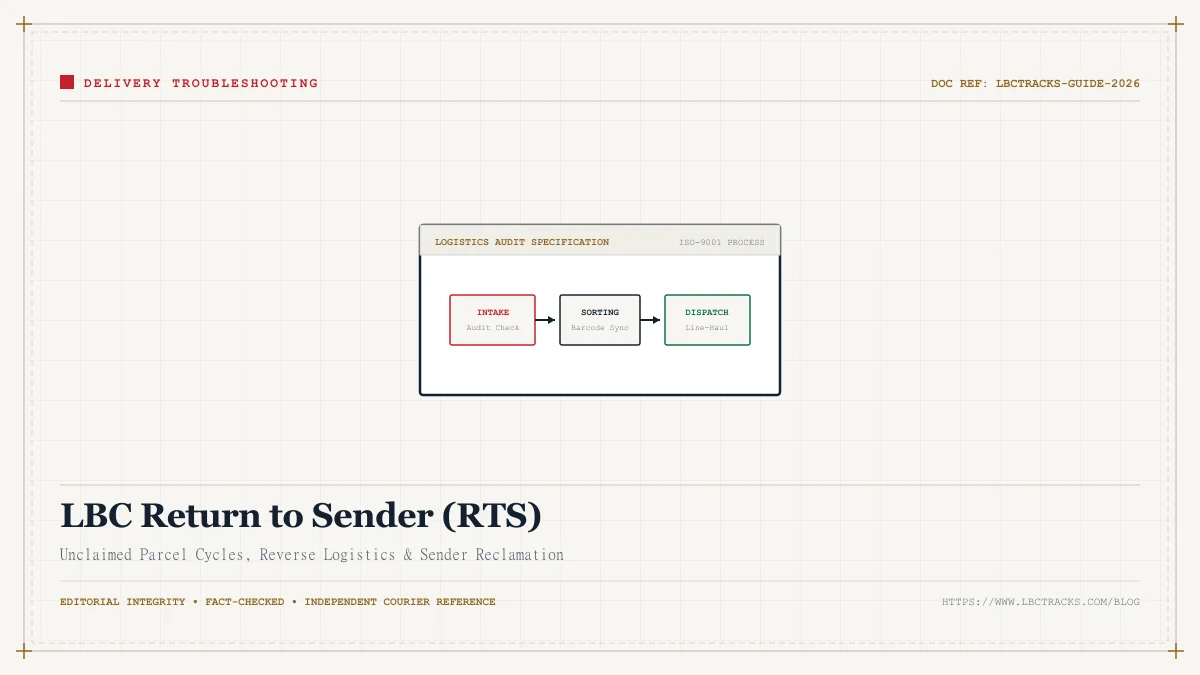
Here is the complete journey an RTS parcel undergoes from failed delivery to sender reclamation:
Local Hub Final RTS Authorization and Quarantine Tagging
The dispatch supervisor at the destination delivery hub reviews the rider's field notes and GPS attempt logs. Once approved, the parcel is marked with an official physical "RTS" routing sticker and staged in the return consolidation cage.
Consolidation and Dispatch to Regional Sorting Exchange
The parcel is loaded onto an outbound feeder truck and transferred from the local delivery hub to the nearest regional distribution exchange (such as Cebu Central Hub, Davao Exchange, or San Fernando Hub).
Inter-Island Line-Haul Trunk Transit
The return cargo travels via consolidated overland freight truck, inter-island cargo ferry, or standby air cargo space back toward the central national sorting exchange in Metro Manila or the originating provincial distribution center.
Central Exchange De-Consolidation & Origin Routing
High-speed automated sorters scan the return barcode, re-manifesting the package onto the specific regional feeder shuttle assigned to the sender's originating drop-off branch.
Arrival at Originating Branch & Notification to Sender
The parcel arrives at the branch where the sender originally tendered the shipment. Counter staff check in the item, updating tracking to "Received at Origin Branch - Ready for Shipper Claim," and an automated transactional SMS is dispatched to the sender's registered mobile phone.
RTS Timelines: How Long Does the Return Process Take?
How many days will you wait for an RTS package to reach the return counter? Total reverse transit time depends heavily on the geographic distance between the destination delivery hub and your originating branch, as well as the prevailing maritime weather conditions across Philippine sea corridors.
As a general rule, expect reverse logistics to take approximately 1.5 to 2 times the standard forward delivery timeframe. The following table provides typical turnaround schedules across primary domestic transit zones:
| Origin to Destination Corridor | Standard Forward Delivery | Typical RTS Return Transit | Primary Transport Mode |
|---|---|---|---|
| Intra-Metro Manila (NCR to NCR) | 1 to 2 Business Days | 3 to 5 Business Days | Local urban hub feeder shuttles |
| Metro Manila to Major Luzon Provinces | 2 to 3 Business Days | 4 to 7 Business Days | Overland North/South Luzon expressway trucks |
| Metro Manila to Visayas (Cebu, Iloilo, Bacolod) | 3 to 5 Business Days | 7 to 10 Business Days | Consolidated RORO sea ferry & regional trucking |
| Metro Manila to Mindanao (Davao, CDO, GenSan) | 4 to 6 Business Days | 8 to 14 Business Days | Inter-island maritime cargo & provincial trunk line |
| Inter-Island Provincial to Out-of-Delivery Area | 5 to 10 Business Days | 12 to 18 Business Days | Multi-leg maritime barge, feeder van, and municipal hub |
Who Pays for RTS Shipping Fees? Financial & Tariff Policies
A critical concern for senders is the financial impact of a failed delivery. Who is legally and contractually responsible for the freight expenses incurred when a parcel journeys back and forth across the country?
The answer depends entirely on the service model under which the package was tendered:
1. Standard Retail Prepaid Shipments (Individual Padala)
For regular consumer shipments where the sender paid freight charges upfront over the counter at the originating branch, the initial forward freight fee is completely non-refundable. LBC fulfilled its contractual obligation to transport the parcel to the destination city and execute field delivery attempts. Regarding return tariffs, retail policies vary: in many standard consumer transactions, LBC returns the parcel to the originating counter without assessing a duplicate return charge, provided the sender collects the box promptly. However, if return handling fees or storage fees are assessed under specific cargo classifications, the sender must settle these charges before the branch will release the box.
2. Cash on Delivery (COD) and Cash on Pick-Up (COP) Orders
In commercial e-commerce transactions utilizing LBC's COD or COP fulfillment channels, the seller bears the economic risk of consignee refusal. When a buyer rejects a COD parcel or abandons a COP package at a branch, no cash was ever collected to cover freight costs. For corporate account holders and registered online enterprise merchants, LBC automatically bills the return freight tariff to the seller's billing account or deducts the cost from accumulated COD remittance balances.
3. Major E-Commerce Marketplace Returns (Shopee & Lazada)
If you shipped through integrated marketplace logistics platforms where LBC acted as the designated 3PL carrier, return freight policies are governed by platform seller agreements rather than over-the-counter LBC retail rules. Platforms typically absorb legitimate return logistics expenses for verified logistics failures, but charge the return shipping fee (RSF) to the seller if the return resulted from seller fault (such as incorrect item dispatched).
How Senders Claim and Reclaim a Returned RTS Package
Once your tracking log indicates that the package has arrived back at your originating branch, you must claim it promptly. Originating branches enforce an administrative storage window of 30 calendar days for reclaimed RTS items. If a sender ignores notifications and fails to reclaim their property within 30 days, carrier lien provisions permit LBC to move the freight to central salvage storage, auction it to recover unpaid fees, or authorize legal disposal.
Follow this step-by-step checklist to reclaim your returned shipment cleanly:
Wait for the Official "Ready for Shipper Claim" Tracking Status
Do not visit the branch while tracking indicates the parcel is still in transit between regional sorting hubs. Wait until the status specifically confirms physical receipt at your originating drop-off branch.
Gather Mandatory Documentation
Bring the original customer copy of the shipping receipt or waybill slip, plus at least one original, valid government-issued photo ID whose legal name precisely matches the registered sender details.
Settle Any Outstanding Reverse Freight or Handling Tariffs
If your shipment type requires payment for reverse transit, prepare the required cash or digital payment (GCash/Maya) to settle the counter invoice.
Perform an On-Site Physical Condition Audit Before Signing
Inspect the exterior carton or poly-pouch before signing the release log. Verify that the security seal has not been sliced, check for signs of moisture or crushing, and ensure the parcel weight corresponds to the original intake record.
File an Immediate Formal Exception If Items Are Missing or Damaged
If you discover that the packaging was opened or the internal contents were damaged during the reverse transit cycle, refuse to sign the standard release without filing a written "Incident Exception Report" signed by the branch supervisor.
What If the Buyer Still Wants the Package? Re-Shipping Protocols
In many e-commerce scenarios, an RTS status triggers panic because the buyer genuinely still wants the merchandise. Perhaps the buyer was hospitalized, experienced a family emergency, or was unreachable due to regional telecommunications outages during the rider's delivery attempts.
Can you simply ask LBC to "turn the parcel around" and deliver it back to the buyer? No. Courier operational software does not permit recycling a closed, RTS-terminated waybill. Once the reverse manifest is logged, the chain of custody requires the item to return to the sender.
To successfully get the merchandise to your customer, follow this re-shipping protocol:
- 1. Let the RTS Complete Its Route: Allow the package to finish its return journey to your originating branch and claim it following standard reclamation steps.
- 2. Contact the Buyer to Verify Address and Contact Details: Confirm the buyer's complete delivery address, including specific house number, street, barangay, and recognizable physical landmarks. Verify two separate working mobile phone numbers.
- 3. Book a Brand New Shipment Under a Fresh Waybill: Tender the parcel at the counter as a new transaction. A new 12-digit tracking code will be generated, establishing a clean delivery SLA and dispatch priority.